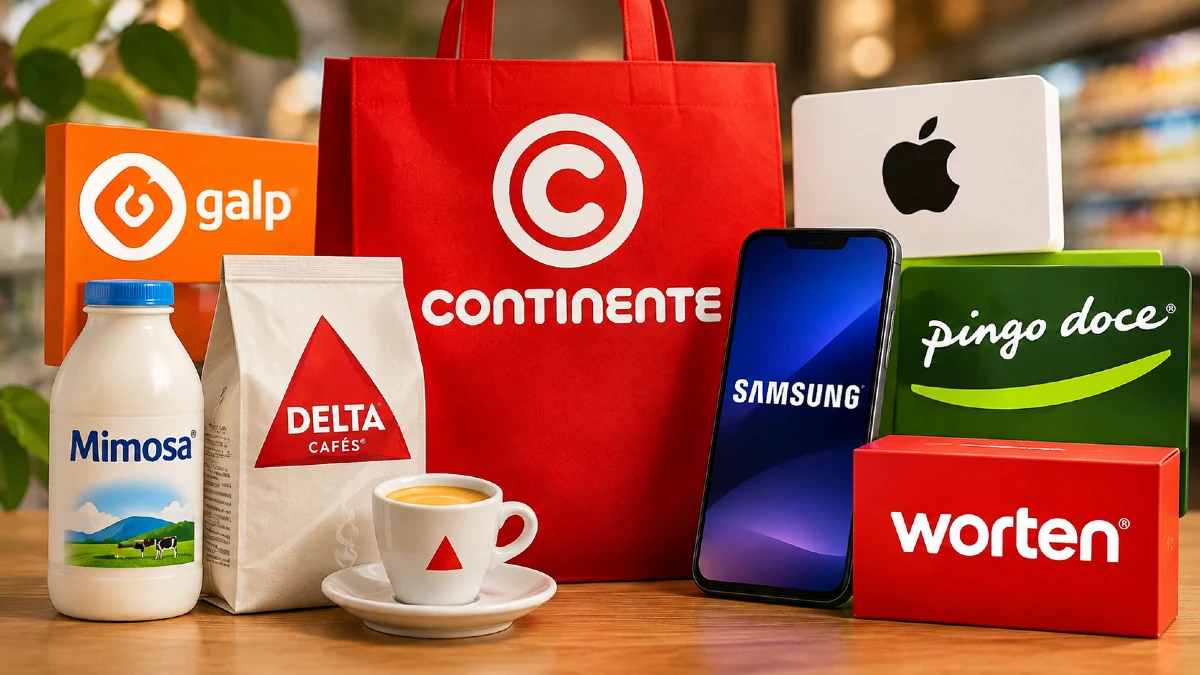
Continente, Delta Cafés and Samsung lead Portugal’s Superbrands 2026 consumer ranking. Beyond these familiar names, another interesting pattern emerges: nine of the country’s top 20 brands are Portuguese, sharing the spotlight with international giants such as Apple, Nike and Coca-Cola.
Published in May 2026, the study offers an insight into the brands that have become part of everyday life in Portugal and how consumers perceive them. It also reveals some differences between generations, particularly when it comes to the growing importance of technology brands.
There is, however, an important distinction to make. This is a ranking of brand perception, not an objective assessment of product quality or value for money.
Continente, Delta Cafés and Samsung top the 2026 ranking
The consumer survey conducted as part of the Superbrands 2026 programme places Continente, one of Portugal’s largest supermarket chains, firmly in first place. It is followed by Delta Cafés, the country’s iconic coffee brand, and South Korean electronics giant Samsung.
The top three illustrate just how varied consumer preferences can be, bringing together supermarkets, everyday consumer products and technology.
According to the published results, Continente also ranks first across all five dimensions examined by the study. Its leading position is consistent across every generation surveyed, from Baby Boomers to Generation Z.
Delta Cafés stands out for its progress. Between 2025 and 2026, the Portuguese coffee company reportedly achieved the strongest improvement across all five indicators, while ranking among the top three brands in three of them.
Portugal’s 20 most highly ranked brands
The Superbrands 2026 consumer ranking brings together businesses from retail, food, technology, sport, automotive manufacturing, energy and telecommunications.
Here are the top 20 brands, in the order published by the study:
| Rank | Brand | Country of origin |
|---|---|---|
| 1 | Continente | Portugal |
| 2 | Delta Cafés | Portugal |
| 3 | Samsung | South Korea |
| 4 | Apple | United States |
| 5 | Nike | United States |
| 6 | Adidas | Germany |
| 7 | Lidl | Germany |
| 8 | Pingo Doce | Portugal |
| 9 | Nestlé | Switzerland |
| 10 | Zara | Spain |
| 11 | Mercedes-Benz | Germany |
| 12 | Coca-Cola | United States |
| 13 | Galp | Portugal |
| 14 | EDP | Portugal |
| 15 | BMW | Germany |
| 16 | Mimosa | Portugal |
| 17 | NOS | Portugal |
| 18 | MEO | Portugal |
| 19 | Vodafone | United Kingdom |
| 20 | Worten | Portugal |
Nine of the top 20 brands are Portuguese, representing 45% of the ranking. They operate in very different industries, from supermarkets and food products to energy and telecommunications.
This is a significant presence in a list that also includes some of the world’s most recognisable companies.
It does not necessarily mean, however, that consumers spend more money on Portuguese products. The study measures which brands people recognise and how they perceive them, rather than recording their actual purchasing behaviour.
Why do Portuguese brands feature so prominently?
A closer look at the ranking reveals the importance of businesses that are deeply embedded in everyday Portuguese life.
Continente and Pingo Doce are closely associated with grocery shopping. Delta Cafés and Mimosa are equally familiar names in everyday food consumption, while Galp and EDP are major players in energy. NOS and MEO provide telecommunications services, and Worten is a well-established electronics retailer.
For many households, these are brands encountered regularly, sometimes almost without thinking about them. That familiarity can help strengthen brand awareness and the sense of connection consumers feel towards a company, both of which feature in the study.
According to the published findings, five sectors account for 77% of the brands in the top 20: retail, food, technology, sport and telecommunications. Retail is particularly prominent, leading across the different dimensions examined.
Yet it would be misleading to conclude that Portuguese consumers systematically favour domestic brands over foreign competitors. International companies are strongly represented, with several occupying positions near the top of the ranking.
The results instead suggest a market in which familiar Portuguese businesses coexist with some of the world’s most established international brands.
Younger generations place greater importance on technology
The Superbrands 2026 study also identifies differences in how consumers perceive brands according to their age.
Continente retains its number-one position across all generations. However, technology becomes increasingly important among Millennials and Generation Z, even overtaking food in certain indicators.
This shift is also reflected in comparisons between sectors. Between 2023 and 2026, technology reportedly gained four percentage points in relevance, while the automotive sector increased by approximately five points. Telecommunications, by contrast, recorded a slight decline.
These changes do not necessarily indicate that younger consumers are spending more on technology products. Rather, they suggest that technology brands are becoming more prominent in the perceptions measured by the survey.
The distinction matters. A brand can enjoy considerable recognition or inspire strong loyalty without necessarily being the one a consumer purchases most frequently.
How does Portugal’s Superbrands ranking work?

Established in Portugal in 2004, the Superbrands programme recognises brands through a selection process combining consumer research with assessments carried out by a panel of industry professionals.
For the 2026 edition, the consumer survey conducted by research company AMINT examined five dimensions:
- Awareness: how readily consumers recognise a brand or recall it spontaneously.
- Uniqueness: the extent to which a brand is perceived as different from its competitors.
- Trust: the confidence consumers place in the brand.
- Identification: the personal connection or sense of affinity consumers feel towards it.
- Needs satisfaction: how well consumers believe the brand meets their expectations.
A panel of 15 marketing and brand management professionals also contributes to the process. Its assessment considers factors such as market position, longevity, reputation, customer loyalty and consumer acceptance.
The programme includes several categories of recognition, notably general, national and corporate distinctions.
It is therefore important to distinguish the consumer survey ranking from the final selection of brands awarded Superbrands status. Although related, the two outcomes are not based on exactly the same process.
Does the Superbrands label guarantee a better product?
Seeing the Superbrands logo on a product, advertisement or company website may inspire confidence. It indicates that the brand has received recognition through the programme’s selection process.
But the label is neither a technical quality certification nor a guarantee of competitive pricing.
The assessment does not involve a systematic comparison of the prices charged by different retailers. Nor does it replace independent product testing, which might assess the reliability of household appliances or compare the performance of competing devices.
A well-known brand may offer an excellent product without being the cheapest option available. Equally, a less familiar company may provide something perfectly suited to a consumer’s needs.
For groceries, comparing prices per kilogram or litre remains a straightforward way to assess value. For more expensive purchases, it is also worth considering repair options, after-sales service and the findings of independent product reviews.
In Portugal, statutory consumer protection does not depend on whether a product carries a commercial quality label. Under Portuguese Decree-Law No. 84/2021, new goods sold by professional retailers to consumers are generally covered by a three-year statutory conformity guarantee, subject to the applicable legal conditions.
Ultimately, Superbrands 2026 offers a revealing snapshot of the companies that occupy an important place in the minds of Portuguese consumers. It tells us something about recognition, familiarity and trust, but it cannot replace careful comparisons when deciding what to buy.