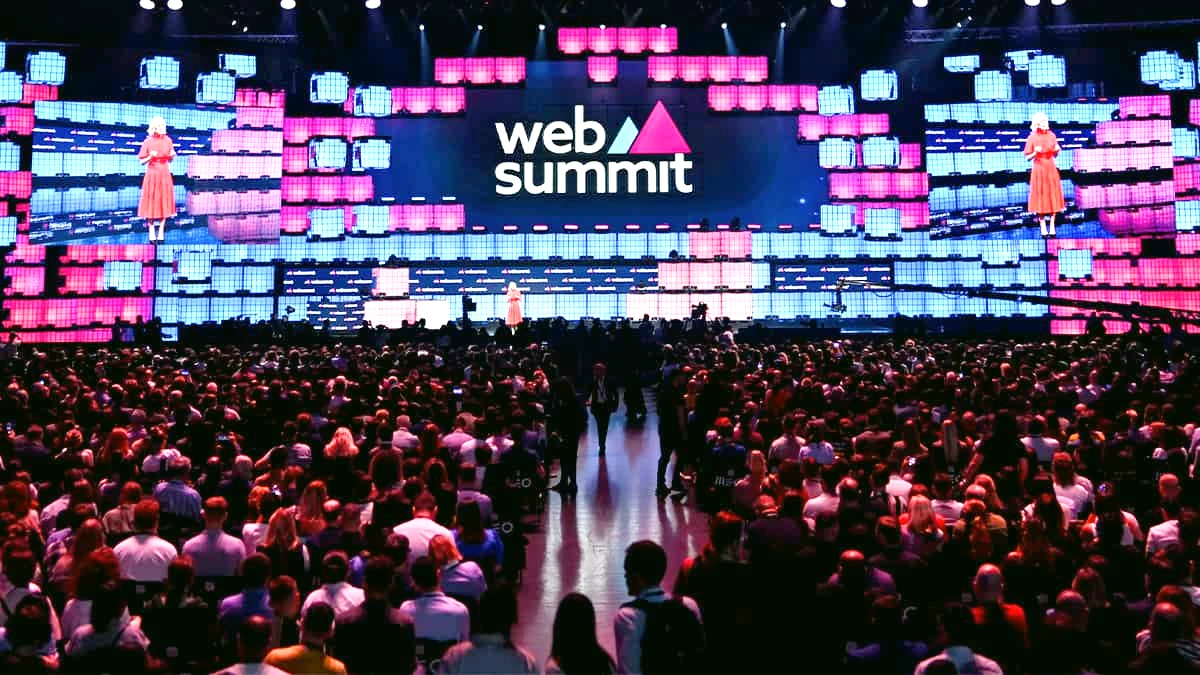
Lisbon is preparing to welcome the global technology industry from 9 to 12 November 2026, as Web Summit returns with artificial intelligence and robotics high on the agenda. From autonomous AI agents to humanoid robots, cybersecurity and the future of work, this year’s discussions promise to move well beyond chatbots and generative AI.
The focus is increasingly on what happens when artificial intelligence leaves the screen and begins to interact with the physical world. How will these technologies change businesses, workplaces and everyday life? And how close are we to seeing them deployed on a meaningful scale?
The event will take place at the MEO Arena and the Feira Internacional de Lisboa (FIL) exhibition halls in Lisbon’s modern Parque das Nações district. Technology executives, entrepreneurs, investors and European policymakers are among those expected to attend four days of conferences, debates and networking.
When artificial intelligence moves into the physical world
For much of the recent AI boom, attention has focused on software: language models, image generators and increasingly sophisticated digital assistants. At Web Summit 2026, another dimension of the technology is set to attract considerable interest.
Known as physical AI, this emerging field brings artificial intelligence together with machines capable of perceiving, navigating and acting in real-world environments.
Representatives from robotics companies including Unitree and AgiBot are among the announced participants. Both companies are developing humanoid robots and other automated systems, reflecting growing commercial interest in technologies once largely confined to research laboratories.
The implications extend far beyond the spectacle of a machine walking, lifting objects or imitating human movements. The real question is whether these systems can become sufficiently reliable, safe and affordable to perform useful tasks outside controlled demonstrations.
Meanwhile, autonomous AI agents are expected to feature prominently in discussions about the future of business. Unlike conventional assistants that respond to individual instructions, these systems can carry out sequences of tasks with varying degrees of independence.
Their potential applications range from administrative processes and customer service to software development and complex business operations.
But greater autonomy also introduces new challenges. Which tasks should companies automate? Who remains accountable when an AI system makes a mistake? How can organisations protect sensitive information while giving increasingly capable software access to their systems?
These are no longer purely theoretical questions.
Still, the presence of robotics companies does not necessarily mean new humanoid models or live demonstrations will be unveiled in Lisbon. Any specific product announcements will need to be confirmed during the event itself.
Technology leaders and European policymakers join the conversation
The Web Summit 2026 speaker line-up brings together some influential names from the technology industry.
Among those announced are Matthew Prince, co-founder and CEO of Cloudflare, Mike Cannon-Brookes, co-founder and CEO of Atlassian, and Richard Socher, an AI entrepreneur associated with You.com and Recursive.
Their participation reflects the breadth of issues facing the digital economy, from cloud infrastructure and cybersecurity to enterprise software and the next generation of artificial intelligence systems.
European institutions will also have a voice in Lisbon.
Henna Virkkunen, the European Commission’s Executive Vice-President responsible for Tech Sovereignty, Security and Democracy, is expected to take part at a time when Europe is attempting to strengthen its technological capabilities while establishing rules for increasingly powerful AI systems.
The challenge is considerable. European policymakers are seeking to encourage innovation and investment without overlooking questions of privacy, copyright, transparency and corporate accountability.
For technology companies, the debate is equally practical: how can they develop and deploy new products while navigating a regulatory environment that continues to evolve?
Artificial intelligence may dominate many of the headlines, but Web Summit’s programme extends well beyond it. Fintech, energy, venture capital, marketing and the changing nature of work are also among the themes scheduled for discussion.
Together, these subjects offer a broader picture of an industry confronting both extraordinary technological possibilities and increasingly complex economic and social questions.
More than a conference: a meeting place for startups and investors
Behind the keynote speeches and high-profile discussions, Web Summit continues to serve another important purpose: bringing emerging companies together with investors, potential partners and international customers.
For a young business hoping to expand beyond its domestic market, the opportunity to meet decision-makers from across the world can be just as valuable as attending a conference session.
The scale of the event is considerable.
According to figures released by the organisers, Web Summit 2025 attracted 71,386 attendees from 157 countries, alongside 2,725 startups and 1,857 investors.
Those figures relate to the previous edition and should not be treated as attendance forecasts for 2026. Nevertheless, they illustrate the international reach the Lisbon gathering has developed.
This year’s programme once again includes networking opportunities, specialist sessions and platforms for emerging companies to present their projects.
For startups, securing investment is only one part of the equation. Meeting prospective customers, testing business ideas against market expectations and developing international partnerships can be equally important.
The presence of entrepreneurs, software developers, established technology companies, investors and policymakers also creates opportunities for conversations that rarely happen within a single industry.
And as AI becomes embedded in more products and services, those conversations are becoming increasingly interconnected. Decisions about technology now involve questions about regulation, employment, infrastructure, energy consumption and public trust.
Web Summit is therefore as much about the conditions needed to bring new technologies into everyday use as it is about the technologies themselves.
Four days to explore what comes next in technology
Web Summit 2026 opens on Monday 9 November and runs until Thursday 12 November, with its main events taking place in Parque das Nações, on the eastern side of Lisbon.
The district, developed around the former Expo ’98 site, provides a fitting setting for a gathering focused on technological change. Its contemporary architecture, exhibition facilities and waterfront location have become closely associated with Lisbon’s international technology event.
The full conference schedule, speaker sessions and practical information are available through the official Web Summit website.
For visitors and industry observers alike, one of the most revealing aspects of this year’s edition may be the growing attention given to technologies capable of acting rather than simply generating information.
Humanoid robots and autonomous AI agents represent two different but increasingly connected directions in artificial intelligence. Both raise questions about what machines will be able to do, how reliably they will perform and how people will work alongside them.
The coming days should offer a clearer picture of which developments are already finding practical applications and which remain largely promises for the future.
For four days in November, Lisbon will once again become a meeting point for the people building, financing, regulating and questioning the next generation of technology.
And this year, the future of AI may be discussed not only on screens, but increasingly in the physical world.