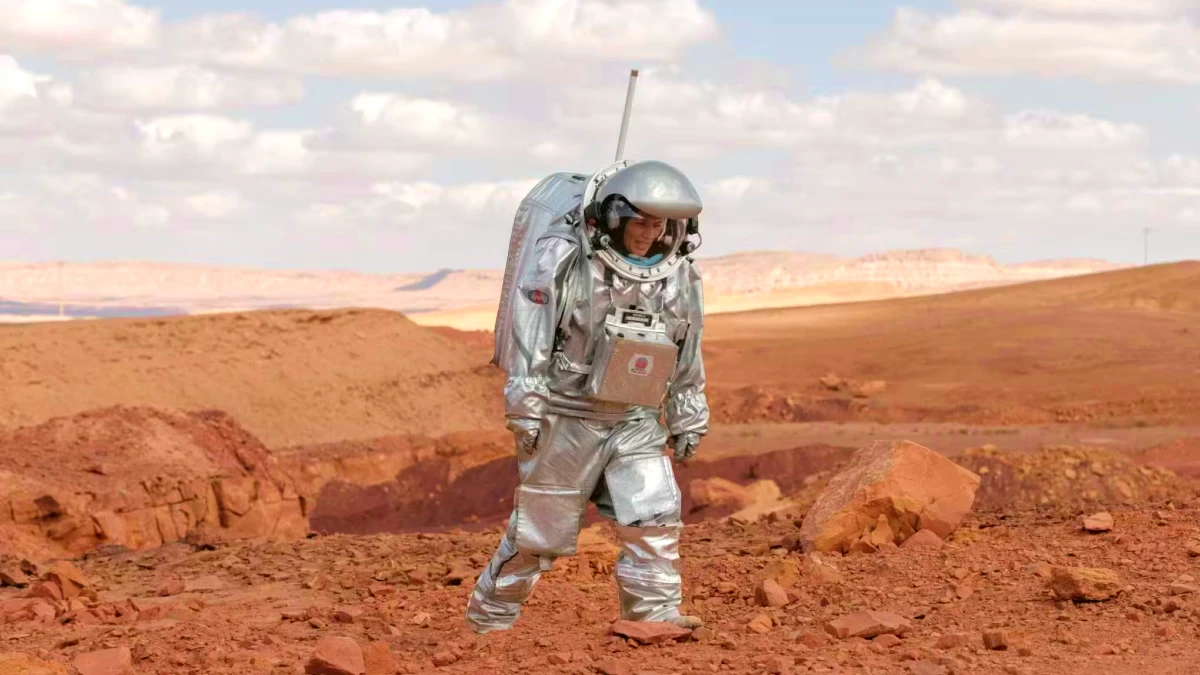
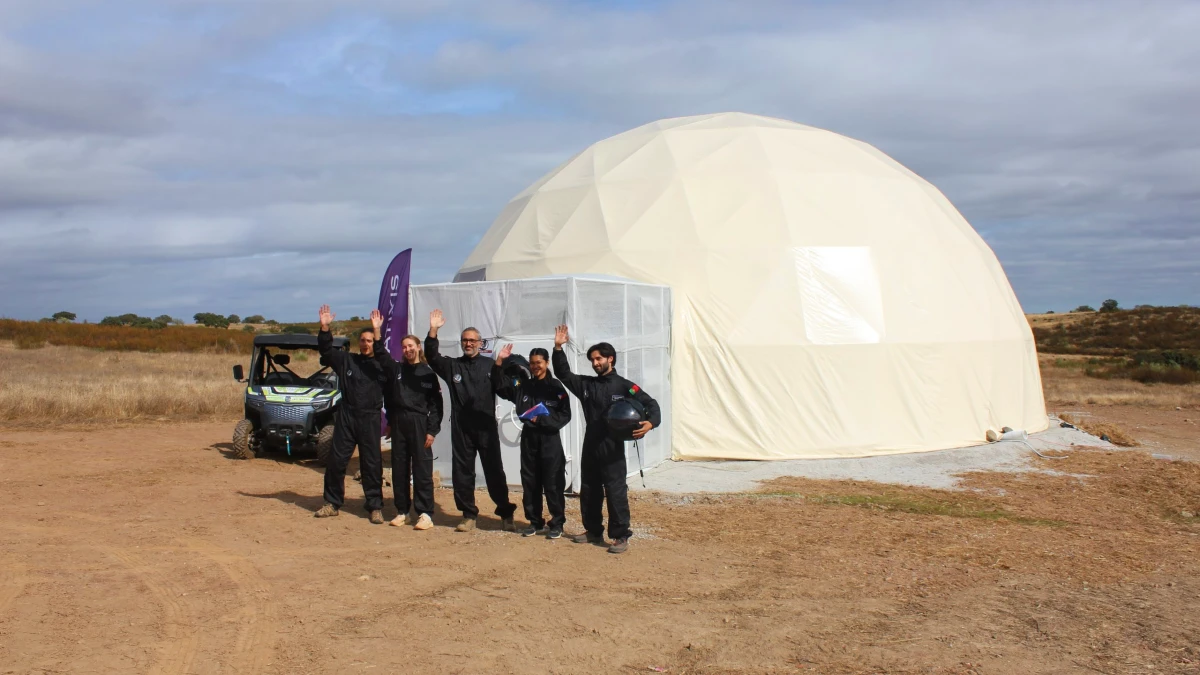
From 5 to 18 April 2027, six astronauts will embark on an unusual mission in Portugal’s Alentejo region: experiencing life on Mars without ever leaving Earth. Based in Monsaraz, near Lake Alqueva, the crew will conduct scientific experiments, operate specialised space equipment and communicate with a mission control centre in Austria. Leading the international expedition, known as AMADEE-27, will be Portuguese engineer João Lousada, a mission manager at the European Space Agency (ESA).
Organised by the Austrian Space Forum, the project will bring together specialists from five countries. Its aim is to recreate some of the practical and psychological challenges that the first humans travelling to the Red Planet are likely to encounter.
For 14 days, Monsaraz will become a Martian base
The 6 crew members will spend two weeks at the Monsaraz Analog Research Station (MARS), in the district of Évora. They will live and work inside a specially adapted habitat designed to reproduce certain aspects of a planetary exploration base.
The mission follows one fundamental rule: participants must carry out their activities as though they were actually on Mars, despite being firmly on Portuguese soil.
During scientific excursions, they will wear simulated spacesuits weighing approximately 50 kilograms. These suits recreate several of the restrictions imposed by real space equipment, including reduced mobility, limited visibility through the helmet and radio-based communications.
Even seemingly straightforward tasks will require careful planning. Collecting a sample, operating an instrument or carrying out a technical procedure becomes considerably more demanding when every movement is restricted by heavy equipment.
A 10-minute delay when communicating with Earth
One of the most interesting features of AMADEE-27 is its approach to communications. Mission control will be based in Vienna, Austria, thousands of kilometres from Monsaraz. But geographical distance is not the real challenge: organisers will deliberately introduce a 10-minute delay into radio communications.
This will reproduce one of the major difficulties facing future missions to Mars. Unlike astronauts aboard the International Space Station, who can communicate with teams on Earth almost instantly, a Martian crew must contend with the time it takes radio signals to travel between the two planets.
An urgent question, therefore, cannot receive an immediate answer. Crew members will need to anticipate problems, make certain decisions independently and coordinate their activities without constant support from mission control.
Developing that level of autonomy is one of the central challenges of human exploration of Mars.
Seventeen scientific experiments planned
According to the official programme presented by the Austrian Space Forum, AMADEE-27 will involve 17 scientific experiments developed with contributions from 22 international research institutions.
The research will examine how the human body responds to demanding conditions, concentration and cognitive performance, life inside an isolated habitat and the use of robots to support astronauts.
Some experiments will measure muscle fatigue and stress during operations. Others will investigate air quality inside the habitat or test systems designed to sustain human life during extended missions.
Robotics will also play an important role. Machines will help explore the surrounding terrain, identify geological formations and gather information for scientific teams.
The value of the simulation therefore goes well beyond observing how six people cope with confined living conditions. It is also about understanding how astronauts, scientific instruments and robots can work together in an environment far removed from Earth.
A Portuguese engineer will lead the mission

The crew will be commanded by João Lousada, an engineer and mission manager at the European Space Agency.
He has spent more than a decade working on International Space Station operations and reached the final stages of the European astronaut selection process in 2022. He is also involved in managing PLATO, an ESA space mission dedicated to the search for Earth-like planets.
For AMADEE-27, he will be joined by five specialists from the United Kingdom, Germany, Italy and Sweden. Together, they bring expertise in medicine, physics, space engineering and exploration.
In the crew announcement published on 2 November 2026, Lousada highlighted the particular significance of leading an international mission in his home country.
Several Portuguese organisations are also involved in the project, including the University of Évora, INESC TEC, NUCLIO and the Observatório do Lago Alqueva, with support from Portuguese technology company Tekever.
Why Portugal’s Alentejo region was chosen
This will not be the first time Monsaraz has hosted a simulated space exploration mission. In 2025, an earlier analogue mission involving Portuguese researchers was carried out in the area.
The 2027 programme, however, represents a step up in scale. It forms part of a wider international series of simulations organised by the Austrian Space Forum and is intended to help prepare for a larger operation planned for 2028.
The landscape around Monsaraz and Lake Alqueva provides suitable terrain for scientific exercises, with open spaces where teams can test equipment, conduct fieldwork and practise some of the procedures required for planetary exploration.
Of course, Alentejo cannot reproduce the full physical conditions of Mars. The Red Planet’s gravity, atmosphere and extreme temperatures cannot be recreated in the Portuguese countryside. Instead, the simulation will focus on operational procedures, equipment performance and the human challenges of working in an isolated environment.
The next milestone is scheduled for 27 November 2026, when the mission partners are expected to sign a cooperation agreement. The field mission will then begin on 5 April 2027, when the six participants enter their temporary Martian outpost in Portugal.