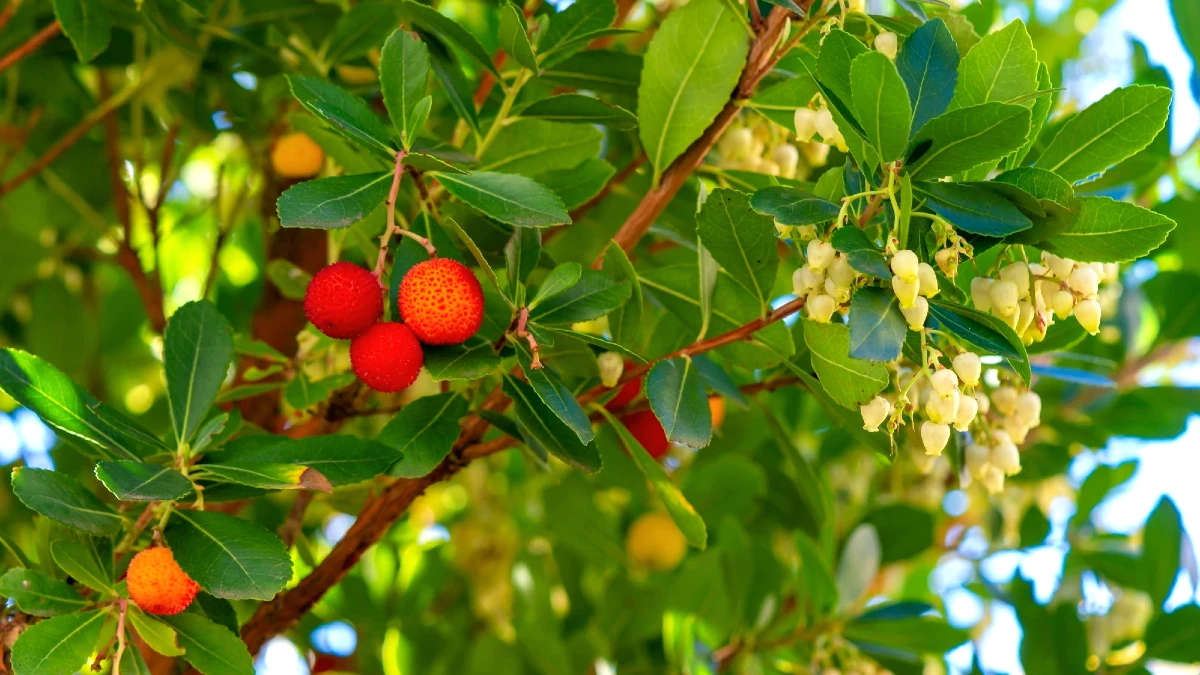
In autumn, something unusual happens in the hills of Portugal. On the same branches, clusters of delicate white and pink flowers appear alongside fruits in shades of green, yellow, orange and red. The medronheiro, the Portuguese name for the strawberry tree (Arbutus unedo), produces its flowers just as the fruits from the previous year’s flowering are reaching maturity.
Between October and January, this remarkable cycle becomes especially visible. While many plants are preparing for winter, the strawberry tree keeps its evergreen foliage, with flowers and fruits at different stages of development sharing the same branches.
The medronheiro grows across much of mainland Portugal, but it is particularly associated with the southern hills, especially the Monchique and Caldeirão mountain ranges in the Algarve. Here, its fruit, known as medronho, has also become the essential ingredient in one of Portugal’s most distinctive traditional spirits.
Why does the strawberry tree produce flowers and fruits at the same time?
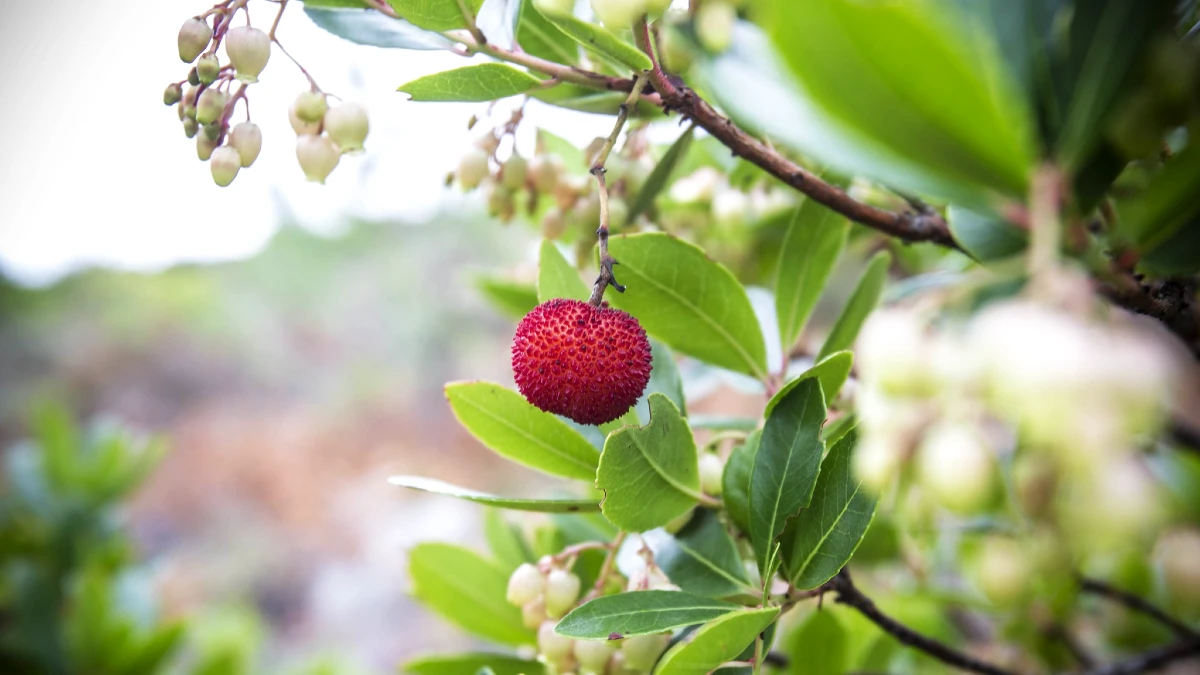
At first glance, the combination of flowers and ripe fruit might suggest that the strawberry tree has an exceptionally fast growing cycle. In fact, the opposite is true: the medronho fruit takes almost an entire year to ripen.
Small, bell-shaped flowers, ranging from white to pale pink, appear in hanging clusters during autumn and may remain on the tree into winter. Once pollinated, particularly by bees, the fruits begin their slow development.
The fruits that ripen the following autumn therefore come from flowers produced the previous year. While one generation of fruit completes its growth, the tree is already producing the flowers that will become the next year’s harvest.
This overlap between two growing cycles creates the tree’s unusual display of colors. Young fruits start out green, gradually turning yellow and orange before developing a deep red color when fully ripe. Depending on the region and weather conditions, ripening and harvesting generally take place from autumn into early winter.
The fruit itself is equally distinctive. Measuring around 2 to 2.5 centimeters across, these small, fleshy berries have a rough, textured surface that resembles a miniature strawberry, which explains the English name strawberry tree. Their flesh is juicy and slightly tart, and the fruits can be eaten fresh when fully ripe.
A tree that thrives where other species struggle
The medronheiro is remarkable for more than its fruit. Native to the Mediterranean region and parts of western Europe, this evergreen species has an impressive ability to adapt to challenging environments.
It grows on hillsides, in Mediterranean scrubland and on poor, rocky or degraded soils. Usually only a few meters tall, it can reach around ten meters in favorable conditions. Its irregular trunk, with shades of brown and reddish bark, and its rounded crown also make it an attractive ornamental tree.
Its resilience is particularly valuable in Portugal. The medronheiro tolerates dry conditions and can regenerate after wildfires. Even when fire destroys its above-ground growth, the tree can produce new shoots from surviving underground structures, allowing it to recover and gradually recolonize burned areas.
This ability makes it an important species in Mediterranean landscapes where wildfires and soil degradation are recurring environmental challenges.
Its autumn flowering also plays a useful ecological role. At a time when fewer plants are in bloom, strawberry tree flowers provide food for pollinators. Meanwhile, the ripening fruits offer an additional food source for birds and mammals as other seasonal resources become less abundant.
In the Algarve, medronho is part of local tradition
For communities in the regions where the strawberry tree grows abundantly, its history is closely connected to traditional knowledge passed down through generations.
In the hills of the Algarve, harvesting medronho has been part of the autumn calendar for generations. The fruits are gathered once sufficiently ripe, with care taken not to damage the new flowers growing on the same branches.
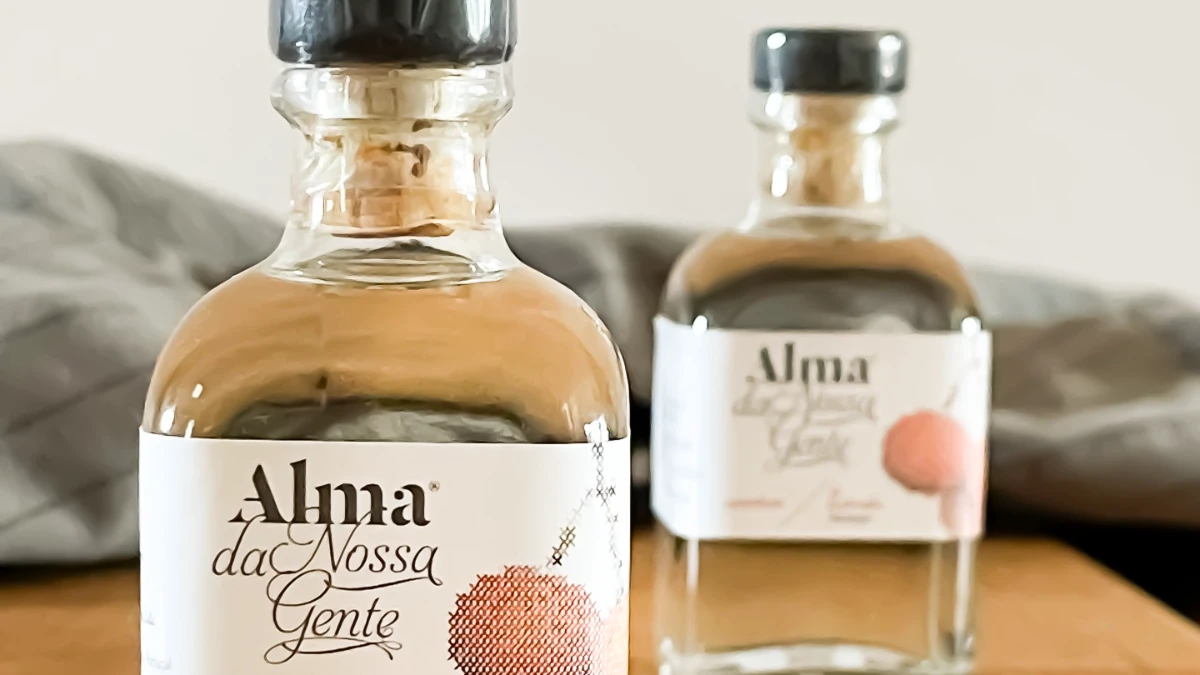
They can be enjoyed fresh or made into jams and preserves. But their best-known use is undoubtedly aguardente de medronho, the traditional Portuguese spirit produced from fermented strawberry tree fruit.
After harvesting, the fruit intended for distillation is left to ferment for several weeks before being distilled, traditionally using copper stills. This practice became particularly established in the inland Algarve, where harvesting and producing medronho spirits once provided an additional source of income for rural families.
In Monchique, the tradition remains important enough to inspire initiatives aimed at preserving these skills. Since 2017, the Reviver Tradições program has brought local residents together to take part in traditional harvesting activities around Águas Alves.
Despite a common misconception, eating a ripe medronho is not the same as drinking alcohol. The strong spirit associated with the fruit is produced through a deliberate process of fermentation followed by distillation.
A remarkable autumn sight across Portugal
The medronheiro is found throughout much of mainland Portugal, so there is no need to travel all the way to the Algarve to see one. It is particularly common in scrubland, on hillsides and in certain rocky environments.
From October through early winter, the tree becomes especially easy to recognize. Look for evergreen leaves, hanging clusters of small pale flowers and rounded fruits ranging in color from green to bright red, all growing on the same plant.
However, the fruits should only be picked when the species has been identified with certainty, and always with respect for private property and cultivated land. Wild strawberry trees now grow alongside plantations managed specifically for fruit production.
The simultaneous presence of flowers and fruit perfectly captures what makes this tree so unusual. As one year’s medronhos turn red and reach maturity, the medronheiro is already preparing the following autumn’s harvest.