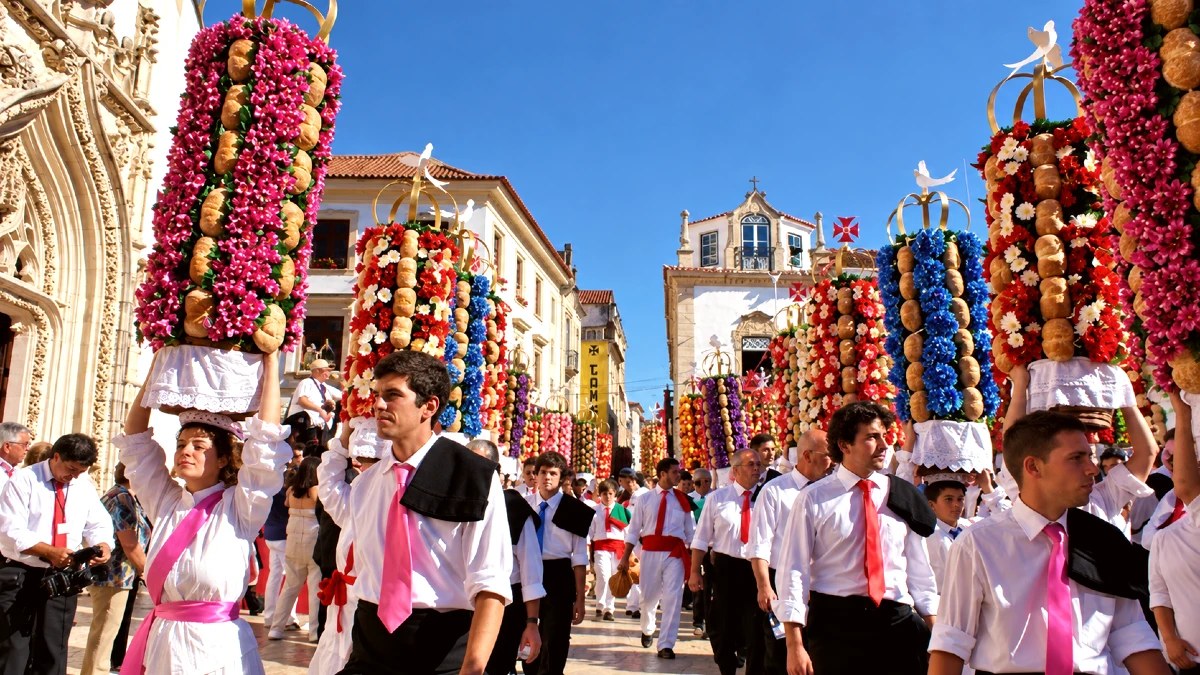
Every four years, Tomar undergoes a remarkable transformation. Thousands of handmade paper flowers fill the streets of this historic town in central Portugal, colourful decorations cover the façades, and an extraordinary procession makes its way through the old town. At the heart of the spectacle, women dressed in white balance towering arrangements of bread, flowers and wheat on their heads, sometimes reaching almost their own height.
This is the Festa dos Tabuleiros, or Festival of the Trays, one of Portugal’s most spectacular traditional celebrations. Yet behind the elaborate decorations and festive atmosphere lies a much deeper story, bringing together religion, ancient agricultural rituals, charity and a strong sense of local identity.
Held only once every four years, each edition is a major occasion for Tomar. The next festival is scheduled for 3–12 July 2027, when the town is once again expected to welcome visitors from across Portugal and beyond.
A tradition with roots stretching back centuries
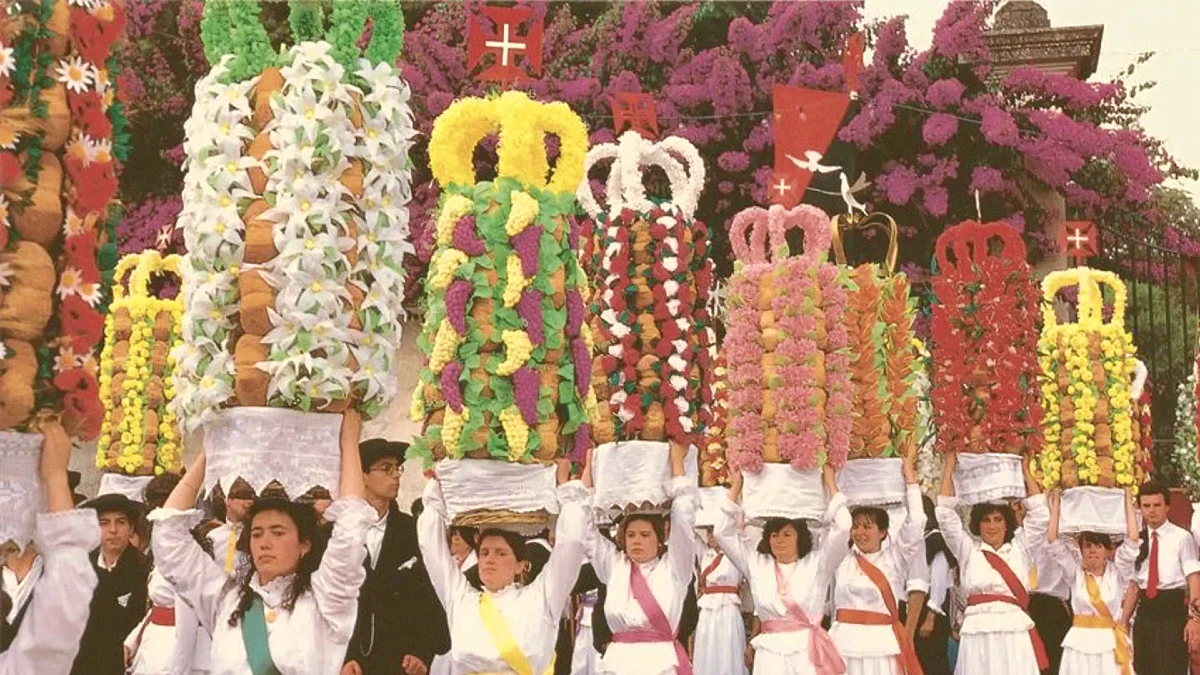
The origins of the Festa dos Tabuleiros are traditionally associated with devotion to the Holy Spirit, which became increasingly widespread in Portugal during the Middle Ages. These Christian celebrations are closely linked to Pentecost, commemorating the descent of the Holy Spirit upon the apostles.
Portuguese tradition also connects Queen Elizabeth of Aragon, wife of King Dinis and later canonised as Saint Elizabeth of Portugal, with the development of religious brotherhoods and charitable institutions dedicated to the Holy Spirit in the early 14th century. The queen remains an important figure in Portuguese history, particularly remembered for her generosity towards the poor.
However, tracing every element of today’s festival to a single event or historical figure would be difficult. Some interpretations suggest that the celebrations may preserve elements of much older agricultural rituals, possibly dating back to pre-Christian times. The prominent use of bread, wheat, flowers and symbols of abundance, together with the festival’s seasonal character, has helped sustain this theory.
Over the centuries, these different influences gradually became intertwined. In Tomar, the celebrations dedicated to the Holy Spirit developed their own distinctive customs, eventually becoming a tradition deeply embedded in the town’s identity.
Why do women carry towering structures of bread on their heads?
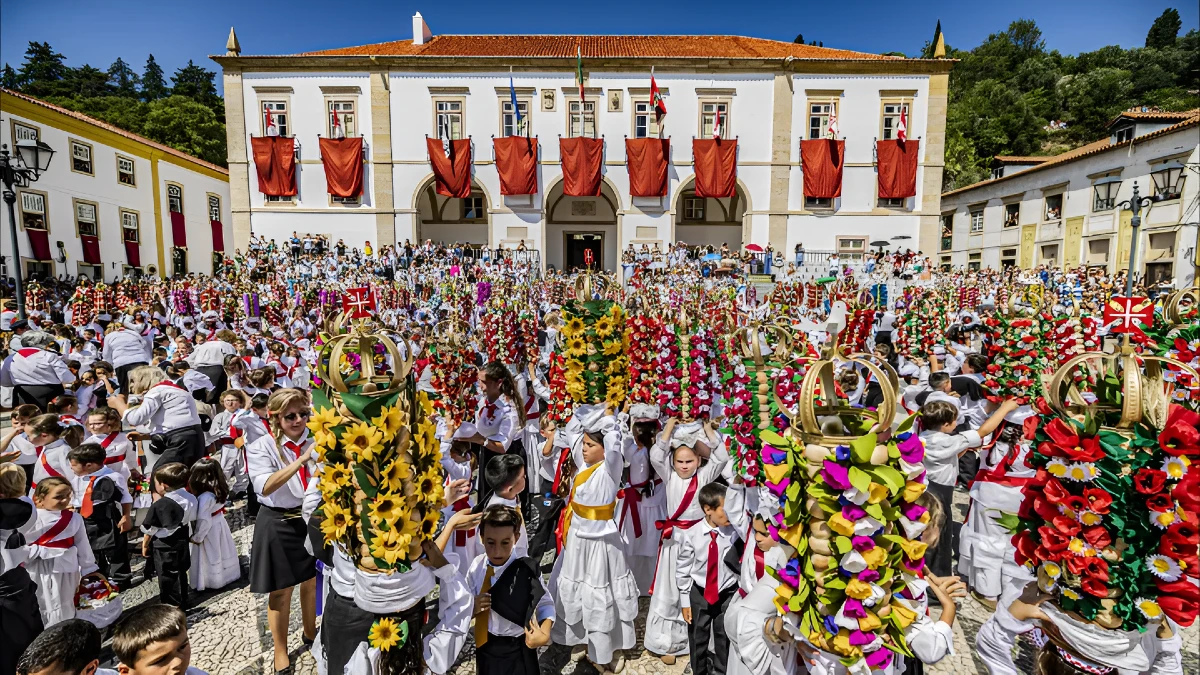
The most striking symbol of the festival is undoubtedly the tabuleiro, the elaborate structure carried by each woman. Creating one involves considerable skill and preparation, with every element carrying a particular meaning.
Rising from a basket balanced on the bearer’s head, the vertical arrangement is built around rows of bread and decorated with paper flowers, greenery and ears of wheat. At the top sits a crown, usually surmounted by a dove representing the Holy Spirit or by a cross.
Traditionally, the tabuleiro should stand approximately as tall as the young woman carrying it. The effect during the main procession is extraordinary: hundreds of brightly coloured structures appear to float above the crowd, creating a moving forest of flowers.
But the bread is far more than decoration. It recalls one of the central principles of the old Holy Spirit festivities: sharing food and supporting the poorest members of the community.
This spirit of generosity was expressed through the distribution of the Pêza, traditionally consisting of bread, meat and wine. Such ceremonies reflected the idea of a community brought together through shared resources, regardless of individual wealth or social standing.
Oxen also once played an important role in these rituals of abundance. They were traditionally slaughtered, with the meat subsequently distributed among local residents. Animal sacrifice was discontinued in 1966, although decorated oxen still take part in the procession today, accompanied by flowers and music.
For a few days, Tomar becomes a city of flowers
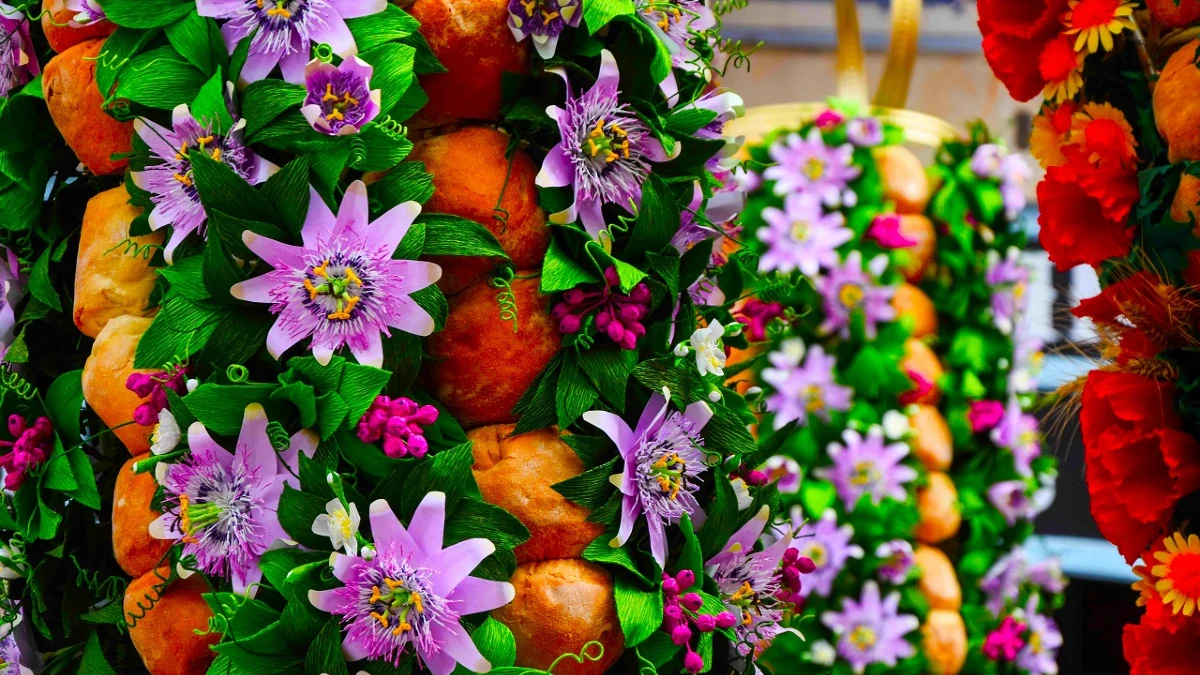
The main procession may be the festival’s most famous moment, but it is only one part of a much larger celebration. Preparations involve a significant proportion of Tomar’s residents for weeks, sometimes even months, before the event.
One of the most remarkable traditions is the decoration of the historic streets. Hundreds of local volunteers spend thousands of hours crafting countless paper flowers and ornamental displays entirely by hand.
Each street develops its own design, which is traditionally kept secret until the decorations are unveiled. When the streets finally open to visitors, familiar corners of Tomar become almost unrecognisable. Ceilings of suspended flowers, intricate geometric patterns, botanical arrangements and decorated façades temporarily transform the old town into an extraordinary open-air installation.
Several ceremonies also mark the different stages of the festival. The Procession of the Crowns and Banners of the Holy Spirit is among the first important solemn occasions. Representatives of the various parishes parade alongside musicians, carrying crowns and banners that recall the celebration’s religious origins.
Other processions follow, including smaller parades of the Tabuleiros. The different parishes gradually come together in Tomar ahead of the main Sunday procession.
During the Grande Procissão dos Tabuleiros, the women and their accompanying partners finally make their way through the town. The contrast between white dresses, brightly coloured flowers, rows of bread and beautifully decorated streets creates the unforgettable image that has come to define this Portuguese tradition.
Festa dos Tabuleiros returns to Tomar in July 2027
The next edition is scheduled to take place from 3 to 12 July 2027. With the Festa dos Tabuleiros held only every four years, anticipation is already building for its return.
Its rarity is a major part of its appeal. During the celebrations, visitor numbers increase dramatically, and accommodation in Tomar and the surrounding area can become difficult to find. Anyone planning to attend the 2027 festival would therefore be wise to arrange their stay well in advance.
A visit also offers the opportunity to explore a town whose history extends far beyond this remarkable celebration. Tomar is closely associated with the Knights Templar, their successors in the Order of Christ and the magnificent Convento de Cristo, a UNESCO World Heritage Site. The historic centre, the Church of São João Baptista, the former synagogue and the wooded Mata Nacional dos Sete Montes provide plenty of reasons to stay a little longer.
Yet for a few days in July 2027, another chapter of Tomar’s history will take centre stage. It is the story of a tradition passed down and reshaped over centuries, preserving a remarkably simple idea beneath its extraordinary spectacle: celebrating abundance by sharing it with the entire community.