Golf generated an estimated €4.44 billion in economic value added in Portugal in 2025, an increase of 4.8% compared with the previous year. Driven largely by international visitors, the sport contributes to the country’s tourism economy far beyond its golf courses. A new study also estimates that its wider economic impact supports more than 94,000 full-time equivalent jobs.
The findings come from a study conducted by EY-Parthenon for the Portuguese Tourism Confederation (CTP) and the National Golf Industry Council (CNIG), published in autumn 2026. It examines both the economic activity directly associated with golf and its broader effects on sectors such as accommodation, restaurants and tourism services.
The €4.44 billion figure does not represent revenue earned by golf courses. It is an estimate of the value added generated across the economic activities associated with the industry, based on the methodology used by the researchers.
Golf’s economic contribution grows by nearly 5%
According to the EY-Parthenon study published by Turismo de Portugal, the total value added attributed to golf increased from €4.235 billion in 2024 to €4.439 billion in 2025.
The estimated impact on economic output also increased, reaching €9.2 billion in 2025, compared with €8.78 billion the previous year. The report additionally attributes approximately €2.05 billion in employee compensation and €1.16 billion in gross tax revenue to the sector and its wider economic effects.
The study estimates that golf-related activity supports 94,071 full-time equivalent jobs. This figure includes far more than employees working at golf clubs and courses. It also accounts for the broader economic activity attributed to the industry, particularly in tourism.
These estimates, produced through research commissioned by industry representatives, illustrate the potential importance of golf to the Portuguese economy. However, they should not be confused with directly observed employment figures or the revenue actually collected by golf course operators.
The Algarve accounts for two-thirds of golf activity
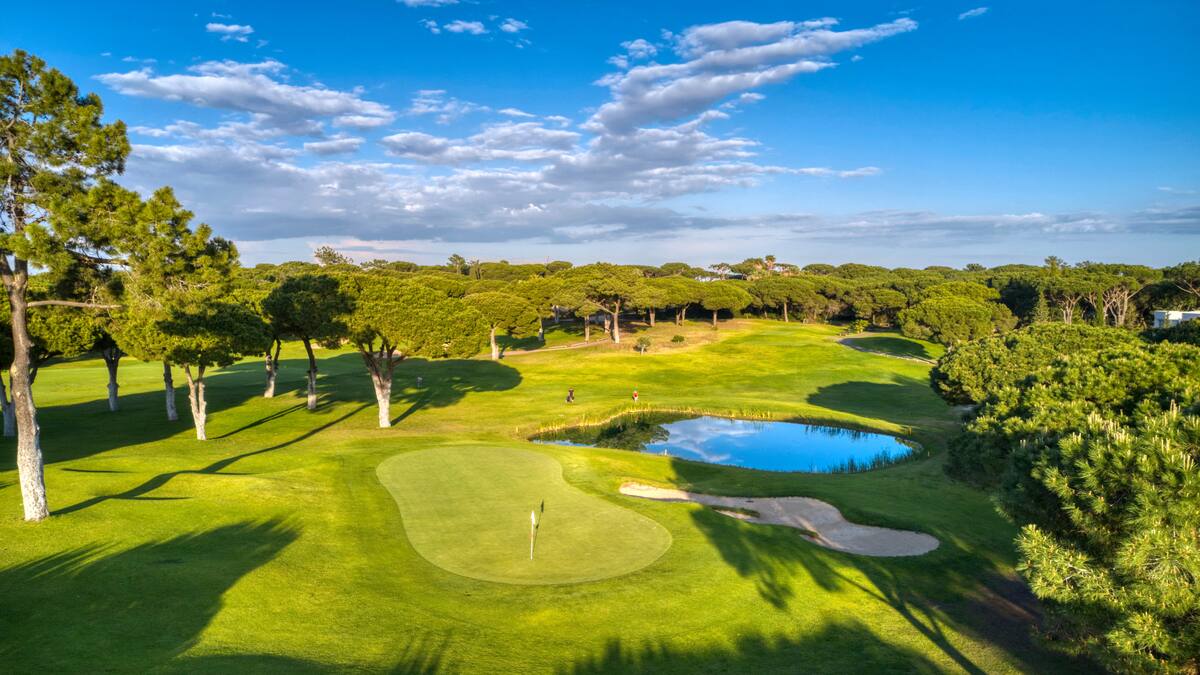
Golf activity in Portugal is heavily concentrated in one region. The Algarve accounted for 66.5% of all recorded rounds of golf in 2025, representing approximately 1.44 million rounds played. The region is also home to nearly 52% of the country’s golf holes, highlighting the scale of its facilities.
The Lisbon region follows at a considerable distance, with 15.2% of rounds played. It is followed by Central Portugal (7.4%), Porto and Northern Portugal (4.8%), Madeira (3.9%) and Alentejo (2.3%).
International visitors play a decisive role in the industry. In 2025, foreign golfers accounted for 74% of all rounds played, a proportion that remained stable compared with the previous two years.
The United Kingdom is by far Portugal’s largest international golf market, accounting for 50% of foreign golfers included in the study. Germany follows with 10%, ahead of Sweden (8%), France (5%) and Ireland (4%).
This strong reliance on international visitors helps explain the close relationship between golf and Portugal’s tourism industry, particularly in the south of the country.
A tourism activity that thrives beyond the summer season
One of golf’s most distinctive economic advantages is its seasonal pattern. Unlike beach tourism, which is heavily concentrated in July and August, golf attracts visitors during the milder months of spring and autumn.
October accounts for 12% of all rounds played throughout the year, followed by April with 11%. By comparison, July and August each represent just 6% of annual activity.
For tourism businesses, this pattern offers a significant advantage. Golf vacations can help sustain demand for hotels, restaurants and other local services during periods when visitor numbers are traditionally lower.
Nuno Sepúlveda, president of the CNIG, also emphasized this wider contribution when presenting the study. He highlighted golf’s connections with other economic activities and its role in distributing tourism demand more evenly throughout the year.
These findings underline golf’s distinctive position within Portugal’s tourism industry. Its economic importance extends well beyond the courses themselves, encompassing the spending generated in destinations that welcome visiting golfers. The Algarve remains the main beneficiary, while the figures also demonstrate the importance of British visitors and the sector’s contribution outside the peak summer season.