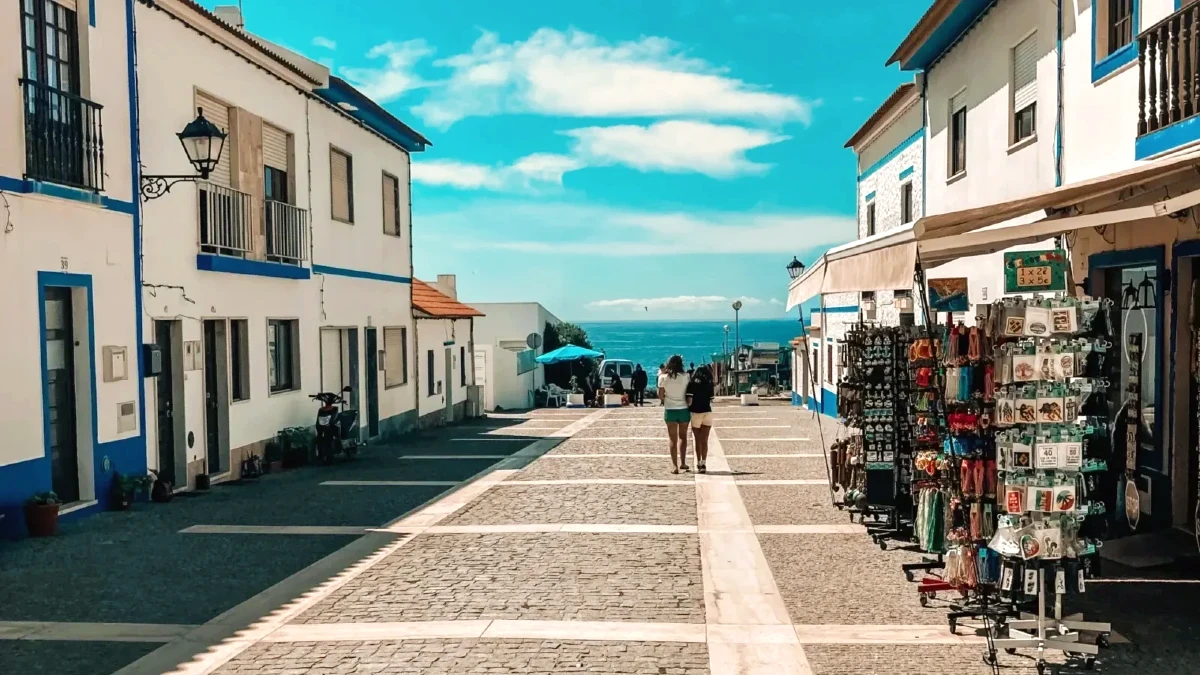
On Portugal’s Alentejo coast, a small village of whitewashed houses and blue-trimmed windows overlooks some of the Atlantic’s most dramatic beaches. Porto Covo, around two hours south of Lisbon, is a place of secluded coves, rugged cliffs and coastal walks that reveal a quieter side of Portugal. Its appeal lies not in grand monuments or busy resorts, but in the contrast between a compact village centre and the wild coastline just beyond it.
Part of the municipality of Sines, Porto Covo has long been associated with fishing and life by the sea. Today, its traditional streets, nearby beaches and access to the Rota Vicentina make it an appealing destination for a weekend escape or a longer exploration of the Alentejo.
The village is particularly attractive to travellers who enjoy discovering places on foot. Within a short distance of its central square, narrow streets give way to Atlantic viewpoints, sandy beaches and paths winding above the cliffs.
A whitewashed village with a distinctly Alentejo character
Porto Covo’s charm begins in its streets. White façades, blue details and low-rise houses create the familiar architectural palette of coastal Alentejo, while the village’s compact layout makes it easy to explore without a fixed itinerary.
At its centre is Praça Marquês de Pombal, a square that provides a natural starting point for a visit. From here, the surrounding streets lead towards small cafés, restaurants and the ocean.
The village’s history is connected to the transformations that followed the devastating Lisbon earthquake of 1755. Its development is associated with the period of the Marquis of Pombal, whose name remains attached to the main square.
Although Porto Covo retains much of its traditional appearance, it is not an untouched fishing settlement. Tourism has become an important part of local life, especially during the summer, when its beaches and restaurants attract visitors from across Portugal and beyond.
Outside the busiest holiday periods, the pace is generally more relaxed, making it easier to appreciate the village’s streets and coastal scenery.
Four beaches that make Porto Covo worth exploring

The coastline around Porto Covo is anything but uniform. Sandy bays alternate with rocky headlands, and some beaches almost disappear beneath the incoming tide. Each has a different character, making a beach-hopping walk one of the most rewarding ways to discover the area.
Praia Grande: the village’s broad Atlantic beach
Praia Grande is one of Porto Covo’s best-known beaches, offering a wide stretch of sand framed by cliffs. Its relatively straightforward access makes it a popular choice for visitors staying in the village.
In summer, the beach can become busy, but its open setting still feels very different from the densely developed resort areas found elsewhere along Portugal’s southern coast. The Atlantic can produce powerful waves and currents here, so swimming conditions should always be assessed carefully.
Praia dos Buizinhos: a small cove close to the centre
For a more intimate coastal setting, Praia dos Buizinhos lies close to the village itself.
Surrounded by dark rock formations, this small beach offers striking contrasts between pale sand, blue-green water and rugged cliffs. Its appearance changes considerably with the tide, and the available sandy area can become very limited at high water.
It is an attractive stop for photography and coastal exploration, although visitors should pay attention to tides and access conditions.
Praia da Samoqueira: rocks, pools and dramatic scenery
A little farther along the coast, Praia da Samoqueira is known for its distinctive rock formations and small pools that appear among the rocks at suitable tidal conditions.
The landscape is particularly photogenic, with cliffs and stone outcrops creating a series of sheltered-looking spaces beside the ocean. However, the rugged terrain requires care. Slippery rocks, changing tides and Atlantic swell mean that not every pool or cove is safe for swimming.
Praia da Ilha do Pessegueiro: a beach facing a historic island
South of Porto Covo, Praia da Ilha do Pessegueiro offers one of the area’s most recognisable views.
Across the water lies Ilha do Pessegueiro, a small island whose history stretches back to Roman times. The beach is an appealing place to appreciate the island’s position off the coast and the dramatic scenery of this part of Alentejo.
The island also has a place in Portuguese popular culture through Porto Covo, the song associated with musician Rui Veloso.
Ilha do Pessegueiro: the small island with a remarkable past

Despite its modest size, Ilha do Pessegueiro is one of the most historically interesting landmarks near Porto Covo.
The island contains traces of Roman occupation, including remains associated with fish processing and salting. These archaeological features reflect the importance of the Atlantic coast to maritime activity long before Porto Covo became a modern holiday destination.
There are also remains of later defensive structures, linked to attempts to protect this stretch of coastline from maritime threats.
Seen from the mainland, the island’s low silhouette and ruined buildings create a memorable scene, especially when the Atlantic is rough.
Although reaching the island by boat may be possible under suitable conditions, visitors should not assume that regular tourist crossings or organised visits are available. Access depends on local arrangements and sea conditions, and the site lacks the facilities of a conventional visitor attraction.
For many travellers, the best experience is simply to view the island from the nearby beach and coastal paths.
Walking the Rota Vicentina from Porto Covo
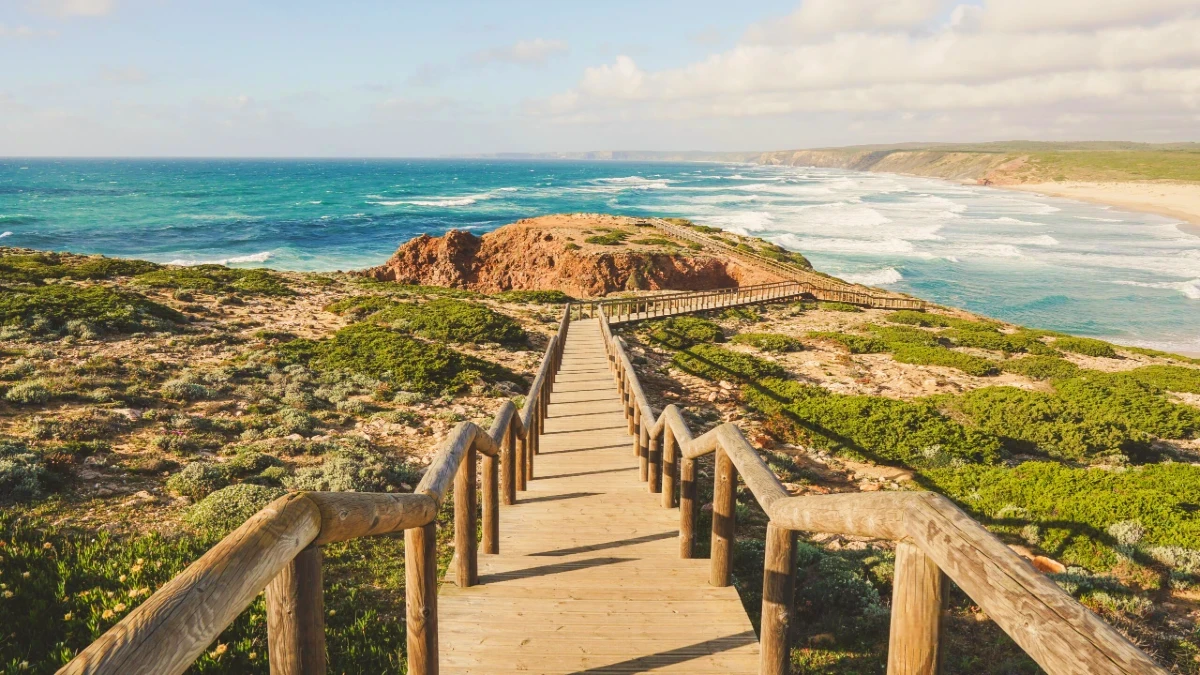
One of Porto Covo’s greatest attractions is its connection to the Rota Vicentina, the network of walking trails that follows the southwest of Portugal through the Alentejo and Algarve.
The village is a starting point for a well-known section of the Fishermen’s Trail, which continues south along the Atlantic coast.
The route passes sandy tracks, rocky viewpoints and stretches of coastline where the landscape feels remarkably open. It offers walkers the chance to see beaches and cliffs from perspectives that are difficult to reach by car.
This is not necessarily an easy seaside promenade. Some sections involve soft sand, exposed terrain and uneven paths, making appropriate footwear, drinking water and sun protection important.
The route is particularly appealing in milder weather, when walking long distances along the coast can be more comfortable than during the hottest summer afternoons.
Travellers who do not want to complete a full hiking stage can still enjoy shorter coastal walks near the village, provided they remain on safe, established paths.
Where to eat and stay in Porto Covo
Seafood is central to the food culture of Portugal’s Alentejo coast, and Porto Covo is a good place to enjoy dishes inspired by the Atlantic.
Freshly grilled fish, octopus and traditional Portuguese seafood preparations are among the foods to look for in local restaurants. The appeal is often in relatively simple cooking that allows the ingredients to take centre stage.
Among the names associated with the village’s dining scene are Restaurante Miramar and Restaurante Zé Inácio, both worth checking when researching places to eat. Opening days, menus and availability should be confirmed before visiting, particularly outside the summer season.
Accommodation ranges from hotels and holiday apartments to guesthouses and rural properties in the surrounding countryside.
Porto Covo Hotel & Apartments is one option for travellers who prefer to stay close to the village and its beaches. Those looking for a quieter countryside setting can explore smaller guesthouses and rural accommodation nearby.
Booking ahead is advisable during peak holiday periods, when demand can be high despite the village’s relatively small size.
How to get to Porto Covo from Lisbon

Porto Covo is approximately 170 kilometres south of Lisbon, with a typical driving journey of around two hours, depending on traffic and the chosen route.
The village lies about 16 kilometres from Sines, making it easy to combine with a wider exploration of the Alentejo coastline.
Travelling by car offers the most flexibility, especially for visitors who want to reach beaches outside the village, explore neighbouring coastal areas or discover inland Alentejo.
Coach services are another possibility. Travellers can check connections from Lisbon through operators such as Rede Expressos, although schedules and the availability of direct services should be confirmed for the intended travel date.
Once in Porto Covo, much of the village can be explored on foot. Its central streets, viewpoints and some nearby beaches are close enough to discover without a vehicle.
For more distant coves and hiking routes, however, visitors should consider the terrain and the distance involved before setting off.
When is the best time to visit Porto Covo?
Porto Covo has a different atmosphere depending on the season.
Summer brings warmer weather, beach holidays and the greatest number of visitors. It is the liveliest time of year, although popular beaches and accommodation can become busy.
Spring and autumn are particularly appealing for walking, photography and exploring the surrounding coastline. Temperatures are often more comfortable for hiking, while the village generally feels less crowded outside school holidays and major weekends.
Winter offers a quieter experience, with dramatic Atlantic scenery and fewer tourists. However, visitors should expect changeable weather, stronger seas and reduced opening hours at some seasonal businesses.
For travellers seeking a combination of coastal landscapes, village life and outdoor activities, the shoulder seasons can offer an especially rewarding balance.
Porto Covo’s greatest strength is the ease with which visitors can move between different experiences: a morning in the village square, an afternoon exploring rocky coves and an evening enjoying local seafood. For anyone planning a journey along Portugal’s southwest coast, it makes an excellent base from which to discover the landscapes of the Alentejo.