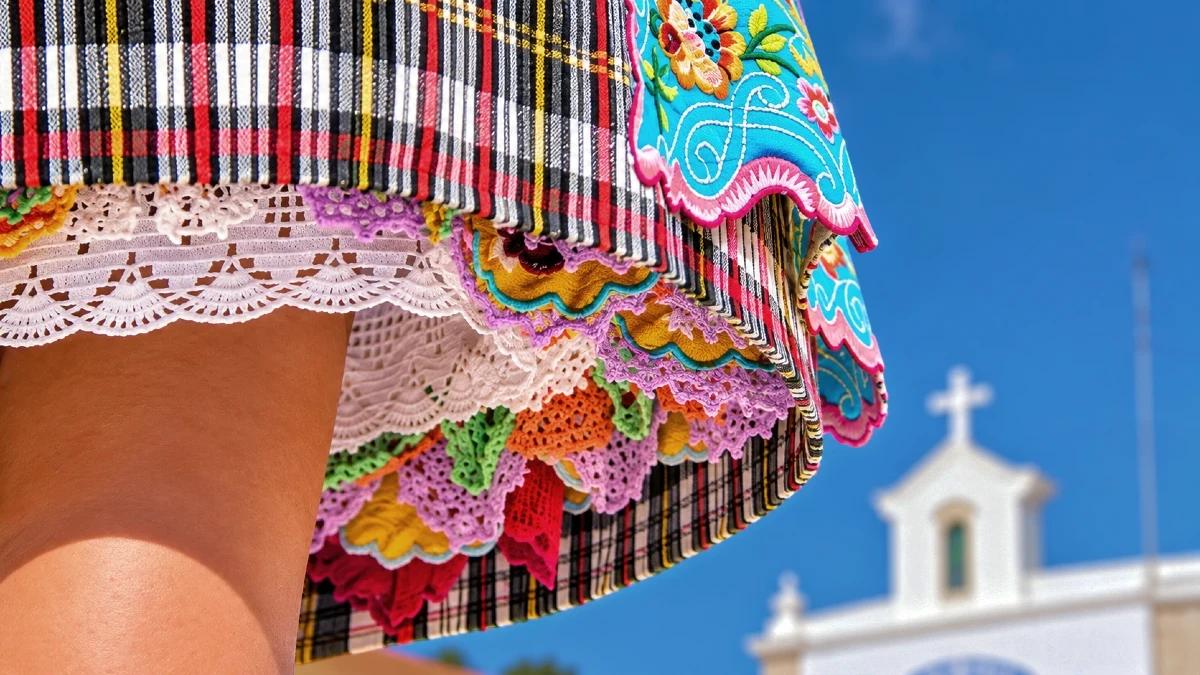
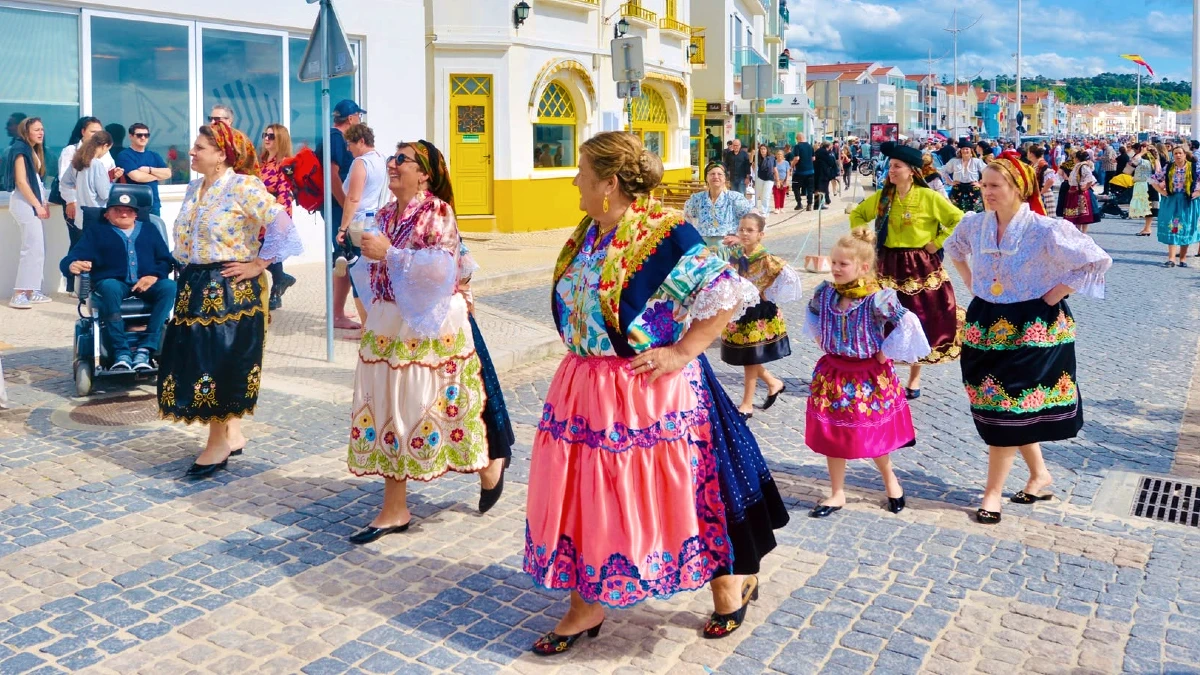
On Portugal’s Atlantic coast, in a town now famous for its giant waves, an extraordinary tradition has survived generations of change. Some women in Nazaré still wear seven skirts layered one over another, their colourful fabrics embroidered with flowers, edged with lace and arranged in a distinctive silhouette. But why seven? The answer leads back to the fishing boats, the women who waited for them on the beach and a collection of legends that continue to shape the town’s identity.
Ask a local about the sete saias, or seven skirts, and you may hear several explanations. Some say the number represents the seven days of the week. Others point to the seven colours of the rainbow, the seven virtues or, most intriguingly, the seven waves of the sea.
No single explanation has been conclusively established. Historians and local residents offer different interpretations, and the familiar seven-skirt costume may have taken its recognisable form more recently than many visitors imagine. Yet almost every version of its story begins in the same place: on the sands of Nazaré, facing the Atlantic Ocean.
Before the giant waves, there were the women waiting on the beach
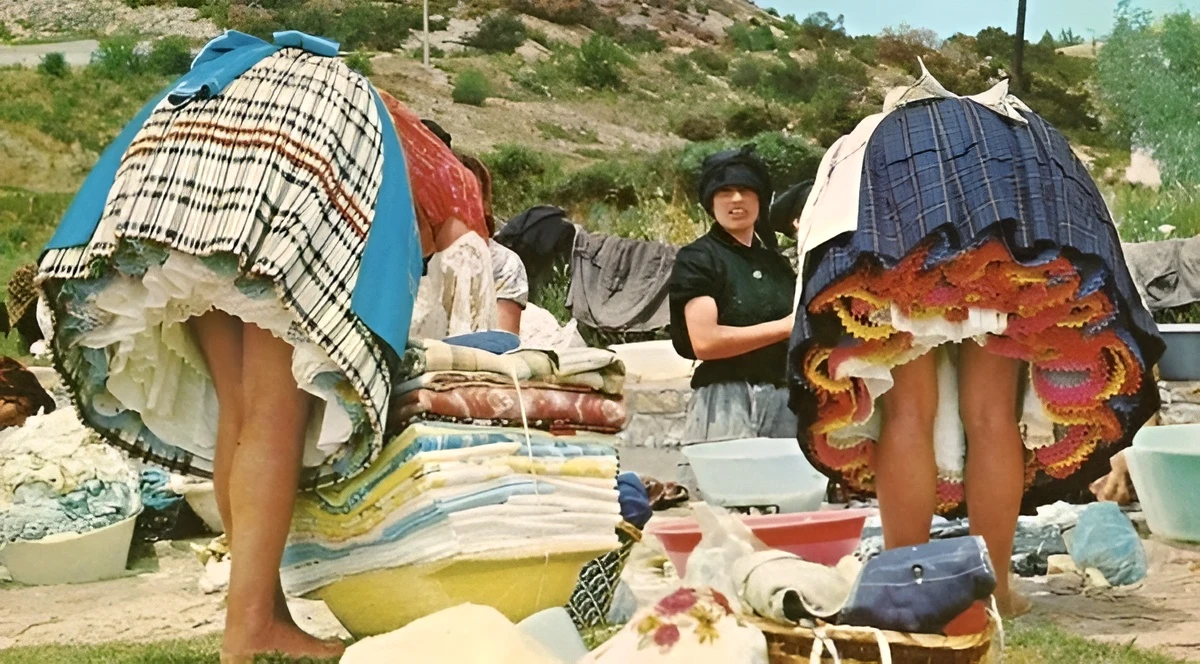
Long before surfers arrived in search of record-breaking waves, Nazaré was a fishing town where daily life revolved around the uncertain return of boats.
The beach was not simply a place to swim or sunbathe. It was a working landscape, crowded with fishing equipment, nets, boats and families whose livelihoods depended on the sea. Fish was cleaned, dried and sold along the waterfront, and women played an essential role in sustaining the local economy.
When their husbands and sons went fishing, women often waited on the sand for their return. The Atlantic wind could be bitterly cold, particularly when combined with damp clothing, wet sand and salt spray.
Their layered skirts offered a practical solution. A woman could lift an outer skirt over her head and shoulders to protect herself from the wind while the remaining layers covered her legs. The arrangement provided warmth without requiring a separate cloak.
This is among the most widely repeated explanations for the custom. But it also introduces an important distinction: women did not necessarily wear exactly seven skirts in everyday life.
The number of layers could vary according to circumstances, personal means and the occasion. Work clothes tended to be more restrained, while festive outfits displayed richer colours, decorative fabrics and carefully chosen accessories.
Over time, what began as a practical way of dressing became one of the most recognisable images of Nazaré.
The legend of the seven waves
There is another explanation, and it is perhaps the most captivating.
According to local tradition, the women of Nazaré once counted the waves to anticipate when fishing boats could safely approach the shore. As each wave arrived, they would fold or adjust part of a skirt, using the fabric to keep track of the sequence.
The seventh wave, the story goes, marked the moment when the sea might briefly become calmer, allowing the boats to land.
It is an evocative image: women standing at the edge of the Atlantic, their skirts becoming a way of measuring the ocean’s rhythm as they watched for the return of their families.
But the story belongs to local folklore, not established maritime science. Waves do not reliably follow a seven-wave pattern that guarantees calmer water, and there is no definitive historical evidence that this practice explains the exact number of skirts.
The legend nevertheless reveals something important about Nazaré. For generations, reading the sea was not a recreational skill. It was part of everyday survival.
Other explanations draw on the symbolic significance of seven in European religious and popular traditions. The seven days of the week, seven virtues, seven colours of the rainbow and seven wonders of the world have all been associated with the costume.
Rather than pointing to a single origin, these overlapping stories show how an ordinary garment can accumulate meaning across generations.
Beauty, pride and the social language of clothing
The skirts were not only about warmth or symbolism. They also reflected changing ideas of feminine beauty.
In earlier generations, a narrow waist and rounded hips were often considered desirable. Wearing several skirts created volume around the lower body, producing a fuller silhouette that contrasted with a fitted upper garment.
The effect was deliberate. Layers of fabric, embroidery, lace and colour helped transform an everyday piece of clothing into an expression of personal style.
There was also an economic dimension.
Social anthropologist José Trindade, who comes from Nazaré, has explained in reporting on the town’s traditions that the cost of assembling a traditional outfit could make it an indication of social standing. More skirts, and more elaborate garments, could suggest greater financial means.
A festive costume might therefore communicate several things at once: family resources, aesthetic preferences, local identity and the wearer’s pride in her appearance.
The distinction between everyday clothing and ceremonial dress is particularly important. The richly decorated skirts visitors associate with Nazaré were not necessarily what women wore while handling fish or working on the beach.
Did the seven-skirt tradition develop more recently?
The history becomes more complicated when researchers examine how the costume acquired its standardised appearance.
Some accounts suggest that the precise seven-skirt arrangement was popularised during the 1930s and 1940s, particularly through the work of the local folklore group Tá-mar.
This does not mean that women suddenly began wearing layered skirts in the twentieth century. The practical use of multiple garments was already connected to the town’s maritime life.
What may have changed was the way the costume was presented, preserved and promoted as a symbol of Nazaré.
Folklore groups helped turn regional dress into recognisable cultural heritage, often selecting particular versions of traditional clothing for performances and public celebrations.
The distinction matters. The custom of wearing several skirts and the later image of exactly seven skirts are not necessarily the same historical phenomenon.
How Nazaré changed, and what happened to its traditions

To understand why the skirts carry so much emotional significance, it helps to imagine Nazaré before its transformation into an international surfing destination.
For much of the twentieth century, fishing activity occupied the beach itself. Boats, nets and equipment filled spaces that visitors now associate with holidaymakers, restaurants and seaside promenades.
The construction of a sheltered fishing harbour gradually changed that relationship. Inaugurated in 1983 and opened to navigation in 1986, the harbour offered safer conditions for fishing vessels and shifted much of the working activity away from the main beach.
The waterfront changed with it.
Where families once gathered around boats returning from the Atlantic, visitors increasingly came to enjoy the sand, the sea and the town’s traditional atmosphere. The fish-drying racks that remain visible near the beach became reminders of a working culture that had once dominated everyday life.
Then came another transformation.
The underwater Nazaré Canyon, which helps produce the enormous waves at Praia do Norte under particular ocean conditions, brought international attention to the town. Surfers such as Garrett McNamara helped introduce Nazaré to audiences far beyond Portugal.
Today, the coastline is associated with extreme surfing and spectacular images of waves towering over the lighthouse at the Fort of São Miguel Arcanjo.
Yet the ocean that attracts spectators is the same ocean that generations of fishing families watched with apprehension. The contrast is striking. What is now celebrated as a challenge for elite athletes was once a source of danger for people whose livelihoods depended on putting to sea.
Where to see the seven skirts in Nazaré today
The traditional costume has not disappeared, although it is no longer an everyday sight among younger generations.
Women wearing the characteristic skirts can still sometimes be seen around Nazaré, particularly in Sítio, the historic neighbourhood perched above the main beach. Some continue traditions associated with selling nuts and other goods to visitors, while others wear the costume during festivals, cultural events and local celebrations.
The town’s streets provide a fitting setting for these encounters. Whitewashed buildings, tiled façades and narrow passages reflect a community shaped by fishing, religion and tourism.
The Miradouro do Suberco, overlooking the broad curve of Nazaré beach, offers one of the most memorable views of the coastline. Nearby, the Sanctuary of Our Lady of Nazaré and the small Chapel of Memory recall the town’s long religious history.
According to local legend, the Virgin Mary saved the nobleman Dom Fuas Roupinho from falling over a cliff while hunting. The story helped establish Nazaré as an important place of pilgrimage long before the modern rise of beach tourism.
Down by the waterfront, the traditional fish-drying displays offer another connection to the town’s past. They recall the work of women who prepared and preserved the catch, sustaining households in a community where the sea provided both opportunity and uncertainty.
These places reveal why the seven skirts cannot be understood simply as a colourful costume designed for tourists.
They belong to a much larger story about the women of Nazaré: their work, their ingenuity, their sense of beauty and the ways they preserved their identity as the town around them changed.
Whether the number seven came from waves, symbolism, folklore or a later standardisation of traditional dress remains unresolved. What is clear is that the skirts have outlived the everyday circumstances that once made layered clothing so useful.
In Nazaré, they remain a visible connection between the modern seaside town and the generations who stood on its beach, watching the Atlantic and waiting for the boats to return.