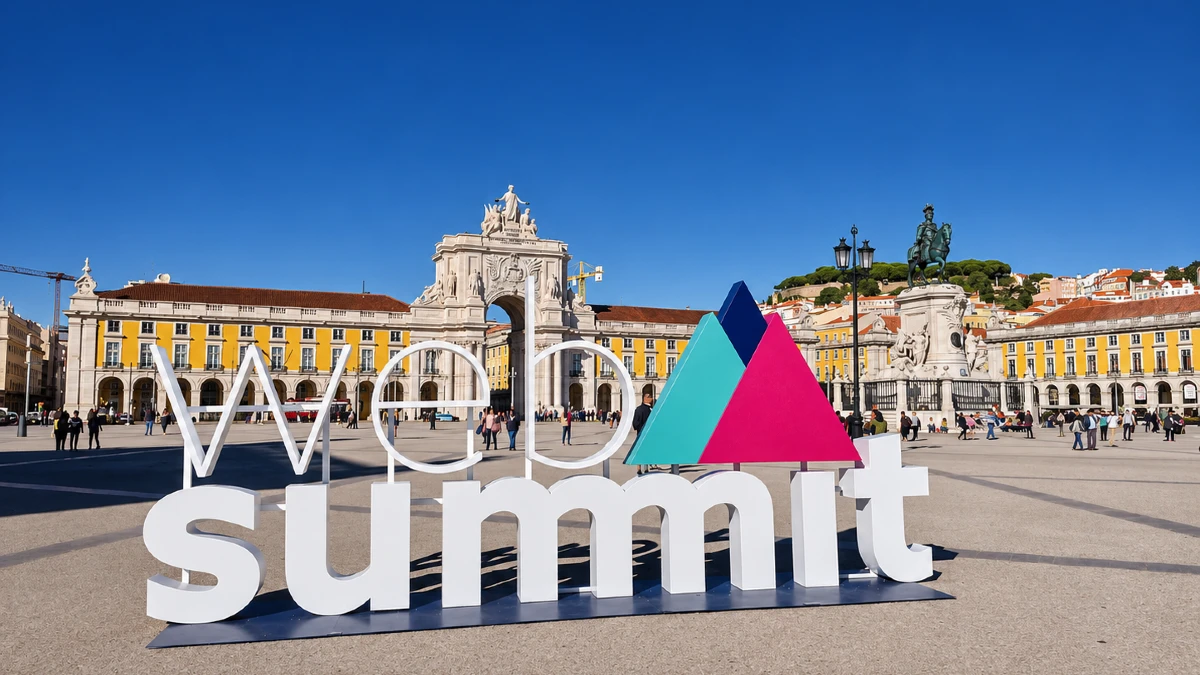
10 years after moving to Lisbon, Web Summit is estimated to have contributed nearly €2.5 billion in economic activity to Portugal. The figure comes from an EY-Parthenon study released on 5 November 2026, marking a decade in which the technology conference has become one of the capital’s most internationally recognised events. Yet behind the headline number lies a more complicated question: how much has Portugal actually gained from a conference supported by substantial public funding?
From visitor spending and employment to the expansion of Portugal’s startup ecosystem, the reported benefits extend far beyond the conference halls. But not every positive development in the technology sector can be credited to Web Summit. As Lisbon celebrates ten years of hosting the event, the economic record deserves a closer look.
€110 million in public funding to keep Web Summit in Lisbon
When Web Summit left Dublin for Lisbon in 2016, it had already established itself as a major gathering for entrepreneurs, investors and technology companies. Its first Portuguese edition attracted 53,056 participants from more than 160 countries, placing Lisbon firmly on the international technology conference circuit.
Two years later, the Portuguese authorities moved to secure the event’s long-term future in the capital. An agreement signed in November 2018 guaranteed that Web Summit would remain in Lisbon through 2028.
The deal involved an initial public funding commitment of €110 million over ten years, equivalent to €11 million annually. Of that amount, €8 million a year was to come from the Portuguese state, while €3 million would be provided through municipal tourism-related funding arrangements. The contract also allowed for financial adjustments, including inflation-related increases.
The reasoning was straightforward: the economic activity generated by the conference, together with the business opportunities it might create, was expected to outweigh the public money spent on hosting it.
That commitment remains central to any assessment of the event’s value. It is also worth remembering that the €110 million figure represents the original contractual commitment, rather than necessarily accounting for every public expense or indirect cost associated with the conference.
Related reading: Lisbon provides €7.24 million in funding for Web Summit.
Nearly €2.5 billion in estimated economic impact

According to an EY-Parthenon study presented on 5 November 2026 1, Web Summit has generated or helped stimulate an estimated €2.492 billion in economic activity in Portugal over its first decade in Lisbon.
That works out at approximately €250 million a year, although the figure combines several different types of economic effects.
Crucially, €2.5 billion does not represent the organiser’s revenue, Portugal’s tax receipts or a net financial return on the public investment. It is an estimate of wider economic activity associated with the event, calculated using the study’s methodology.
Visitor spending provides one of the more tangible measures of that activity. According to EY, Web Summit attendees generated approximately €730 million in spending over ten years, benefiting hotels, restaurants, transport providers, retailers and other businesses.
In 2025 alone, visitor expenditure reportedly reached a record €118 million. For Lisbon, where tens of thousands of international visitors converge each November, the impact is particularly visible in hospitality and tourism.
The study also estimates that tax revenues associated with Web Summit-related activity reached €50.7 million in 2025. Of this, €46 million was linked to economic activity generated by the conference, while a further €4.7 million was attributed to the organiser’s growing corporate presence in Lisbon.
EY additionally estimates that the event supported more than 3,000 full-time-equivalent jobs, reflecting the employment associated with its organisation and wider economic activity.
These are substantial figures, but they require careful interpretation. Economic impact studies use models to estimate how spending circulates through an economy. They do not necessarily establish what would have happened without the event.
The distinction matters when evaluating public investment. Economic activity associated with a conference is not automatically the same as additional wealth created because the conference took place.
The original forecasts were even more ambitious
Portugal’s expectations for Web Summit were high from the beginning. In 2018, the Ministry of Economy published an economic impact assessment by economist João Cerejeira 2, exploring how the conference might develop through 2028.
The report considered several scenarios based on projected attendance, visitor spending and the wider effects of that expenditure on the Portuguese economy.
Under its most optimistic assumptions, Web Summit could generate an annual impact of €385.9 million in national gross output by 2028. That scenario envisaged attendance potentially reaching 120,000 participants.
The actual trajectory has been more modest. In 2025, Web Summit attracted approximately 71,000 attendees, substantially below the figure assumed in the most ambitious projection for 2028. That does not mean the original forecast was necessarily a failure. It was one possible scenario, rather than a guaranteed outcome, and the 2028 target date had not yet arrived.
Nor can the 2018 projections and the latest EY figures be compared directly. They examine different periods and use economic indicators that are not necessarily equivalent. Nevertheless, the contrast illustrates an important point: forecasts made to justify an investment should not be confused with evidence of benefits subsequently achieved.
A meaningful assessment must consider both what was expected and what can reasonably be attributed to the conference after a decade of operation.
Portugal’s startup sector has doubled, but how much credit belongs to Web Summit?

Beyond tourism and visitor spending, Web Summit’s most significant legacy may be its influence on Portugal’s technology sector. Since the conference arrived in Lisbon, the country’s startup ecosystem has expanded considerably.
According to EY, the number of Portuguese startups rose from 2,193 in 2016 to 5,091 in 2025, an increase of 132%. Their combined annual turnover grew from €1.23 billion to €2.85 billion, while exports climbed from €673 million to €1.57 billion. By the end of 2025, the sector supported approximately 28,000 full-time-equivalent jobs.
Web Summit has helped raise Portugal’s international profile, giving local entrepreneurs opportunities to meet investors, build partnerships and reach new markets. But the growth of Portugal’s startup ecosystem cannot be attributed to the conference alone. Education, skilled workers, public policies and private investment have also played important roles.
Another consideration is that the EY-Parthenon study was commissioned by Web Summit itself. Although conducted by an external consultancy, its conclusions should be interpreted with that context in mind.
Lisbon’s growing reputation as a technology hub may be one of the event’s most valuable contributions, yet it remains difficult to quantify. The conference creates opportunities and international connections, but turning those into lasting investment, successful companies and new jobs depends on much more than a few days of networking.
Could Web Summit leave Lisbon after 2028?
The conference’s tenth anniversary comes as negotiations begin over its future in Portugal. The current agreement guarantees Web Summit’s presence in Lisbon until 2028, but no extension has been confirmed.
Speaking to Portuguese business publication ECO 3, founder Paddy Cosgrave acknowledged ongoing discussions with Portuguese authorities. Although he described Lisbon as a second home, he also noted that other European cities were interested in hosting the event.
Lisbon faces practical constraints, particularly the limited capacity of its conference infrastructure, which requires temporary facilities to accommodate the annual gathering.
After a decade of public support, the question is no longer simply how much Web Summit has contributed to Portugal’s economy, but whether a new funding agreement would deliver sufficient additional value.
The conference has strengthened Lisbon’s international visibility and coincided with remarkable growth in the country’s technology sector. Yet its precise contribution remains difficult to isolate. That distinction will be central to assessing whether extending the partnership beyond 2028 represents a worthwhile investment.
- https://thenextbigidea.pt/web-summit-trouxe-25-mil-milhoes-de-euros-a-economia-portuguesa-em-dez-anos-diz-estudo-da-ey/ ↩︎
- https://www.sgeconomia.gov.pt/noticias/gee-relatorio-sobre-impacto-economico-da-web-summit-2016-2028.aspx ↩︎
- https://eco.sapo.pt/2026/11/05/amo-lisboa-mas-ha-outras-cidades-cosgrave-fomenta-misterio-sobre-manutencao-da-web-summit/ ↩︎