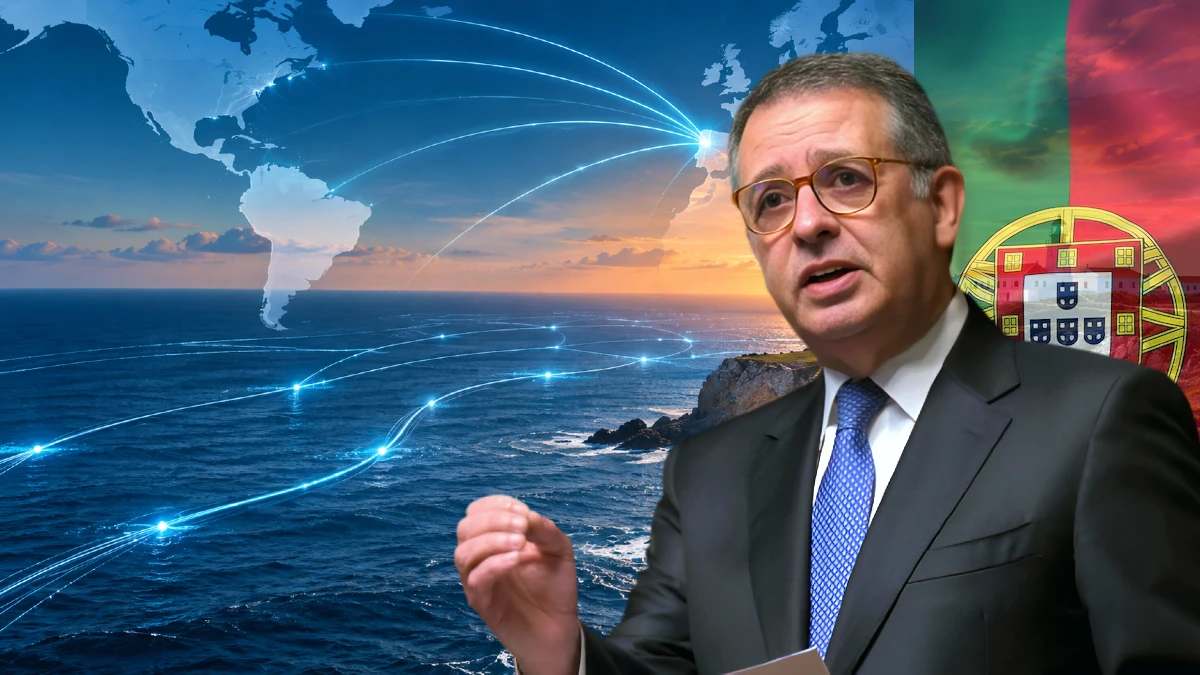
As global powers compete for control over technology and international trade, Portugal is looking to turn one of its oldest advantages into a strategic asset: its position on the Atlantic. With new submarine cables and investment in data centres, the country aims to strengthen its role as a digital gateway between Europe and the Americas. It is an ambition championed by President António José Seguro, who sees digital infrastructure as both an economic opportunity and a question of national sovereignty.
Speaking at the third Euro-Americas Forum, held at Nova SBE in Carcavelos, near Lisbon, Seguro called for closer transatlantic cooperation. Against a backdrop of rising protectionism, geopolitical tensions and increasingly fragmented supply chains, he argued that Portugal could serve as a bridge between the two continents. His remarks outlined a strategic vision rather than announcing a new government investment programme.
Submarine cables could give Portugal a strategic advantage
For centuries, Portugal’s Atlantic coastline helped shape its role in maritime trade. Today, that same geography could become increasingly valuable in the movement of digital information.
During his speech, António José Seguro highlighted the arrival of next-generation transatlantic submarine cables and investment in large-scale, sustainable data centres. Together, these infrastructures support the transmission, processing and storage of the vast quantities of information on which modern economies depend.
They are also becoming increasingly important as artificial intelligence drives demand for computing capacity and reliable international connections.
The Portuguese president believes these developments could position the country as a central hub for digital connectivity between the two sides of the Atlantic.
But the stakes extend far beyond faster internet connections. Submarine cables have become critical infrastructure, making their security and resilience a matter of national and international concern.
Data centres present another challenge. While they can attract investment and strengthen a country’s technological position, their development also raises questions about energy consumption and access to resources.
Between the United States and China, the question of digital sovereignty
Portugal’s ambitions form part of a much wider European debate about technological dependence.
Seguro warned that the development and control of advanced technologies are increasingly concentrated among a small number of powerful actors, particularly in the United States and China.
In his view, this concentration could pose risks to freedom, pluralism and the sovereignty of individual countries.
That does not mean Portugal wants to distance itself from Washington. The president described the United States as an essential partner, particularly through NATO, while also supporting greater European strategic autonomy.
His position reflects one of the central dilemmas facing Europe: how to deepen international cooperation without becoming more dependent on the very powers that dominate global technology.
For Portugal, stronger digital infrastructure could offer a way to gain influence within this increasingly competitive landscape.
Trade and energy: Portugal’s ambitions extend beyond technology
Digital connectivity was only one part of Seguro’s message.
The president also defended open international markets and reiterated Portugal’s commitment to strengthening the European Union–Mercosur agreement, which is intended to deepen economic relations with several South American countries.
Energy was another priority. Seguro pointed to opportunities for cooperation between Europe and the Americas, highlighting Portugal’s potential in emerging technologies such as floating offshore wind power and wave energy.
Countries across the Americas, meanwhile, bring extensive experience in areas including biofuels.
The president also argued that Portugal’s transatlantic relationships should extend beyond its traditional ties with the United States. He specifically highlighted Canada, the Caribbean and Latin America, with particular emphasis on Brazil.
Describing the international situation as “murky waters of uncertainty”, Seguro warned of growing divisions and instability. His proposed response was not to retreat behind national borders, but to build stronger partnerships and more durable alliances.
Whether Portugal can translate that vision into lasting economic influence will depend on more than its geographical location. The country’s emergence as a major transatlantic digital hub will ultimately rest on infrastructure investment, technological security and its ability to attract sustainable economic activity.