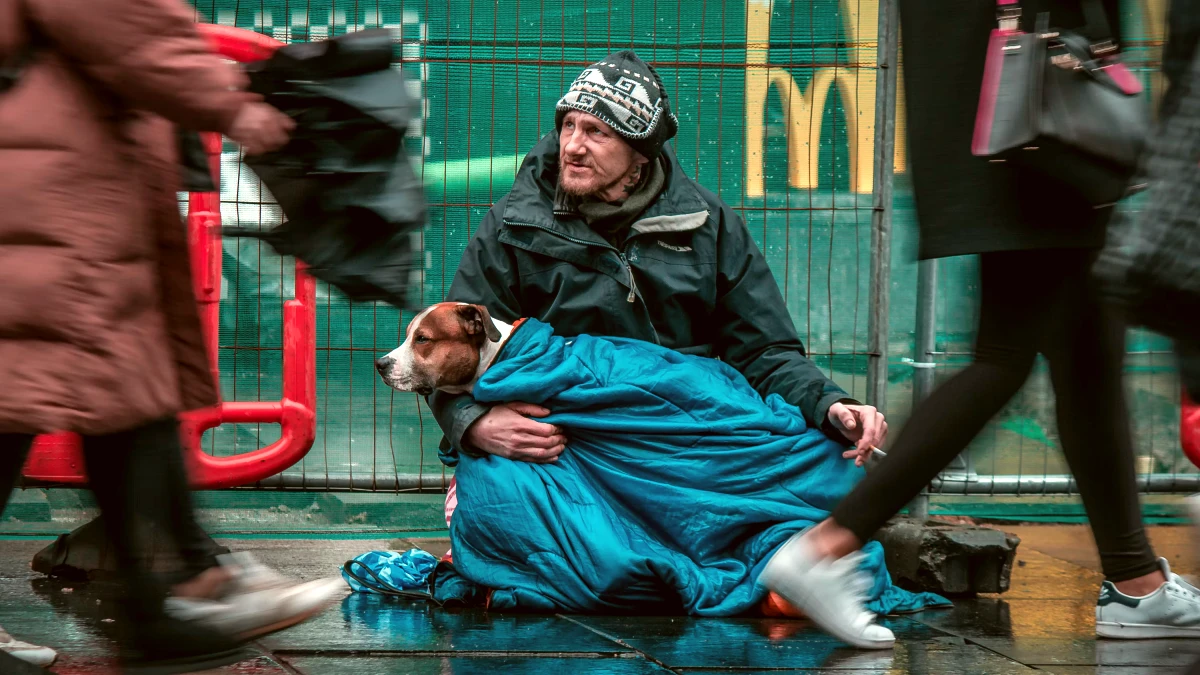
The number of people sleeping rough in Lisbon has risen again, reversing the decline recorded the previous year. At the end of 2025, Portugal’s capital counted 462 people living without shelter, up from 439 in December 2024. The 5.2% increase comes despite an overall reduction in the city’s officially recorded homeless population, revealing a more complicated picture of housing insecurity and social exclusion.
The figures come from the annual survey coordinated by Lisbon’s homelessness planning and intervention network, known as NPISA (Núcleo de Planeamento e Intervenção Sem-Abrigo). The findings describe conditions at the end of December 2025 rather than the current number of people living on the streets.
Lisbon’s progress on rough sleeping has stalled
The increase follows a period of notable improvement. At the end of 2023, Lisbon recorded 548 people sleeping rough, a figure that had fallen to 439 by December 2024. That represented a reduction of almost 20%, raising hopes that the city’s efforts to provide accommodation and social support were making a measurable difference.
Those gains were not sustained in 2025. Although the latest count remains below the 2023 level, the rise to 462 people shows that rough sleeping has become more prevalent again. The increase is relatively modest in absolute terms, but it matters because it concerns people facing some of the most severe forms of social exclusion.
The NPISA report acknowledges that significant challenges remain in reaching those most vulnerable. It calls for stronger preventive measures, improved access to accommodation and more sustainable pathways towards independent housing and social integration.
Why Lisbon’s overall homelessness figures are still falling
At first glance, the broader statistics appear to tell a different story. The total number of people officially recorded as experiencing homelessness in Lisbon fell from 3,122 in 2024 to 2,822 in 2025, a reduction of 300 people, or approximately 9.6%.
The apparent contradiction lies in how homelessness is defined in Portugal. Official statistics distinguish between people classified as sem teto, meaning those sleeping outdoors or in places unsuitable for habitation, and those classified as sem casa, who have temporary accommodation but no permanent home of their own.
The second category includes people staying in reception centres, guesthouses or apartments funded by public authorities and social organisations. Although they are not sleeping outside, they remain without secure, independent housing and are therefore included in the overall homelessness figures.
In 2025, the decline in Lisbon’s total homeless population was largely driven by a reduction in this temporarily accommodated group. Meanwhile, the number of people sleeping rough increased. Both developments can be statistically accurate, even though they reflect very different experiences of homelessness.
This distinction is particularly important when assessing whether conditions are improving. A reduction in the overall count does not necessarily mean that fewer people face the immediate dangers associated with sleeping outdoors, including exposure to severe weather, personal insecurity and difficulties accessing regular healthcare.
More than 900 cases closed after contact was lost
Another finding raises questions about how progress should be measured. Of the 1,391 individual support cases closed during 2025, 916 were closed because social services had lost contact with the people concerned or no longer knew their whereabouts.
By comparison, 112 cases were closed after individuals achieved independence or secured permanent housing through their own means.
These figures require careful interpretation. Closing a support case does not automatically mean that someone has found stable accommodation or escaped homelessness. Where contact has been lost, the available records cannot establish what happened to the person concerned.
Equally, it would be misleading to assume that all 916 individuals remain homeless or are now living on the streets. The figures instead highlight a significant limitation in the ability of support services to track long-term outcomes.
The issue has also been raised by organisations working directly with people experiencing homelessness. In August 2026, the charity Comunidade Vida e Paz told Portuguese news agency Lusa that its outreach teams had not observed a significant reduction in the number of people they encountered in Lisbon, despite the decline reported in municipal statistics.
Is the situation getting worse in 2026?
The most recent annual figures do not establish whether rough sleeping has continued to increase during 2026. As of November 12, no equivalent year-end count was available to provide a direct comparison with the 462 people recorded in December 2025.
However, observations from organisations working on Lisbon’s streets suggest that demand for assistance remains substantial. Comunidade Vida e Paz reported continued outreach activity involving several hundred people during the first half of 2026, without evidence of a marked improvement in the situations encountered by its teams.
These operational figures cannot be directly compared with NPISA’s annual count because the organisations use different methods and may work with overlapping populations. They nevertheless provide useful context for understanding why a fall in the official total should not be interpreted as evidence that homelessness has been resolved.
Lisbon’s municipal homelessness strategy for 2024–2030 includes measures intended to improve emergency accommodation, social support and access to more permanent housing. The latest findings underline the importance of measuring not only how many people remain within the support system, but also whether those leaving it have secured lasting stability.
For Lisbon, the central concern is that fewer people are recorded as homeless overall, while more people are experiencing the harshest form of homelessness: life without a roof over their heads.