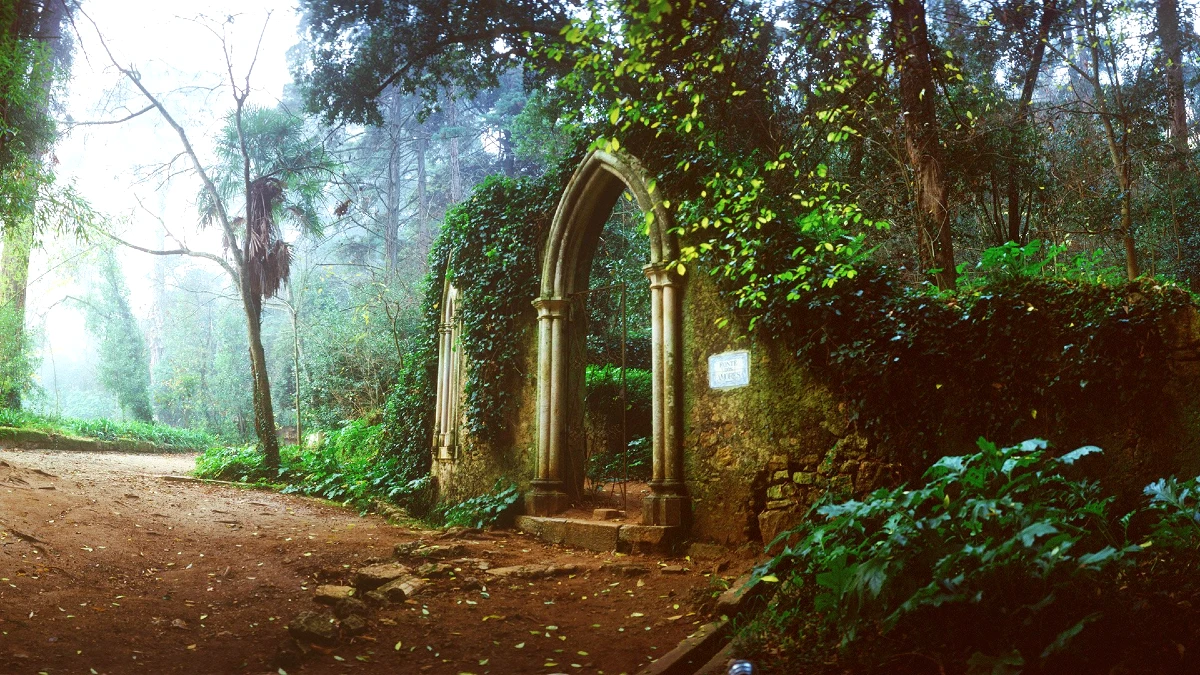
In the Portuguese city of Coimbra, a historic garden keeps alive one of the country’s most extraordinary love stories. It is the story of Pedro, heir to the Portuguese throne, and Inês de Castro, a Galician noblewoman whose forbidden relationship ended in murder, royal revenge and a legend that has endured for nearly seven centuries.
Today, visitors can explore Quinta das Lágrimas, a beautiful estate on the banks of the Mondego River, where ancient fountains, remarkable trees and secluded paths are associated with the ill-fated lovers. According to tradition, it was here that Inês shed her final tears before being killed in 1355 on the orders of King Afonso IV.
Whether the tragedy actually unfolded within these gardens remains uncertain. Yet the combination of documented history and centuries-old folklore has made Quinta das Lágrimas one of Coimbra’s most fascinating places to visit.
Pedro and Inês: a forbidden romance in medieval Portugal

The story begins in 1339, when Prince Pedro, the future King Pedro I of Portugal, married Constança Manuel, a Castilian noblewoman. Like many royal marriages of the Middle Ages, the union was intended to strengthen political alliances rather than fulfil a romantic ambition.
Among the ladies accompanying the new princess to Portugal was Inês de Castro, a young woman from an influential Galician family.
According to legend, Pedro fell in love with Inês almost immediately. Their relationship soon became a source of concern at the Portuguese court, particularly because of her family’s political connections to Castile.
Pedro’s father, King Afonso IV, attempted to separate the couple by sending Inês into exile. The relationship nevertheless continued, and following Constança’s death in 1345, Pedro and Inês eventually lived together in Coimbra.
They had children together, but their happiness came at a political cost. The king feared that Inês and her powerful relatives could influence the succession and threaten the delicate balance of the Portuguese monarchy.
The murder of Inês in 1355 and a kingdom shaken by revenge
On 7 January 1355, Inês de Castro was executed on the orders of King Afonso IV, while Pedro was away. The decision transformed a controversial royal relationship into one of the most enduring tragedies in Portuguese history.
Devastated by her death, Pedro rebelled against his father. Although the conflict was eventually resolved through mediation, the prince never abandoned his determination to punish those responsible.
When Pedro became king in 1357, he pursued the men involved in the killing. Two were captured and executed in 1361, with medieval chronicles describing particularly brutal punishments.
In 1360, Pedro publicly declared that he had secretly married Inês before her death, effectively recognising her as his lawful wife. Historians continue to debate the circumstances and credibility of this alleged marriage.
The legend later acquired an even darker chapter. According to a famous account, Pedro ordered Inês’s body to be exhumed, placed a crown upon her head and forced members of the royal court to kiss the hand of their deceased queen.
There is no reliable historical evidence that this macabre coronation actually took place. Nevertheless, the story became deeply embedded in Portuguese folklore.
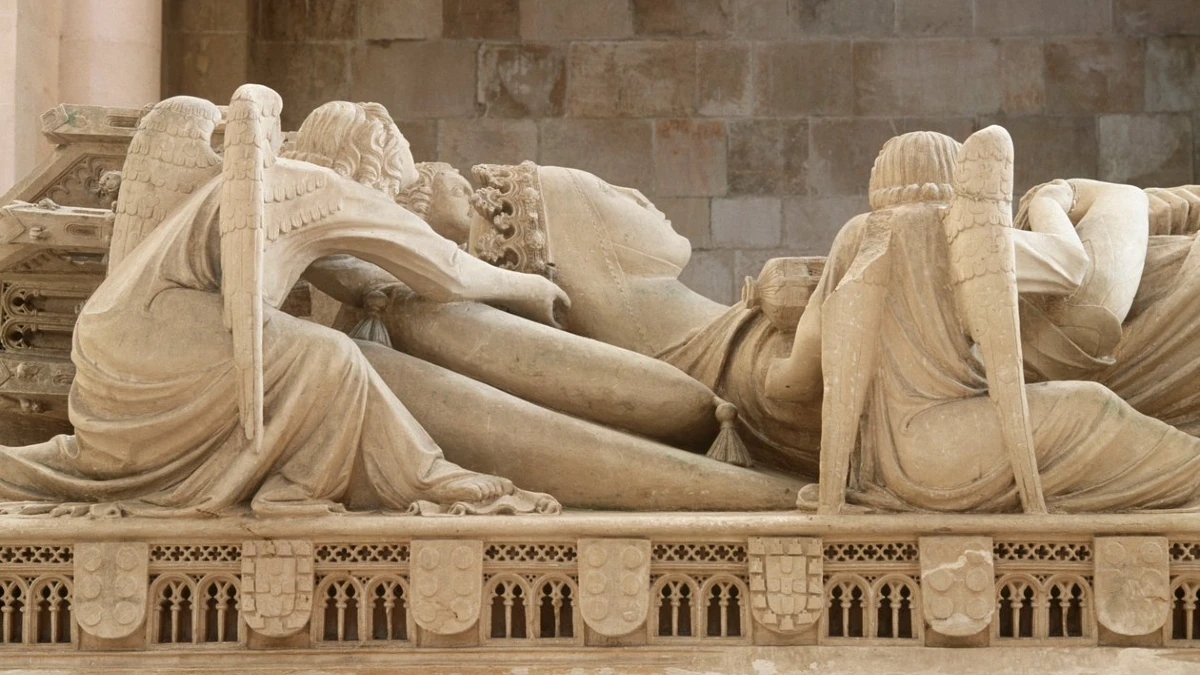
Pedro arranged for Inês to be buried at the magnificent Monastery of Alcobaça, where their elaborate Gothic tombs still stand. The monuments remain among Portugal’s most moving reminders of their relationship.
Quinta das Lágrimas: the fountains, the tears and the legends

Located in Coimbra’s Santa Clara district, on the left bank of the Mondego River, Quinta das Lágrimas is closely associated with the romance of Pedro and Inês.
Two historic fountains lie at the heart of its legends: Fonte dos Amores, the Fountain of Love, and Fonte das Lágrimas, the Fountain of Tears.
The first is linked to a romantic tradition suggesting that water carried secret messages between the lovers. A medieval water channel did connect springs in the area with the nearby Santa Clara monastery, although the idea that Pedro and Inês used it to exchange love letters belongs to folklore.
The Fountain of Tears tells a more tragic story. According to legend, Inês wept so intensely before her execution that her tears created a spring. Reddish marks visible on the stones were later interpreted as traces of her blood.
In reality, the red colouring is associated with natural organisms, including red algae, and historians cannot establish that Inês was murdered at this precise location.
Portuguese literature helped transform these stories into a lasting cultural memory. In his epic poem The Lusiads, Luís de Camões evoked the tragic fate of Inês and the waters that would forever preserve her memory.
Local folklore also claims that her spirit still wanders through the gardens, searching for Pedro. It is one reason the estate occasionally appears in collections of Portugal’s supposedly haunted places.
Exploring the historic gardens of Quinta das Lágrimas

Beyond its romantic associations, Quinta das Lágrimas is an impressive historic estate covering approximately 18 hectares. Its nineteenth-century palace now houses a luxury hotel, but the gardens can be visited independently.
Walking through the grounds reveals centuries of landscape design, with shaded paths, ornamental planting, historic fountains and a remarkable collection of trees.
A medieval-inspired garden evokes the plants and landscapes of Portugal before the great maritime explorations. Elsewhere, mature trees and exotic species reflect the estate’s long botanical history.
Among the most impressive specimens is a Moreton Bay fig, originally from Australia and planted during the nineteenth century. Its enormous roots and spreading branches make it one of the garden’s most striking natural features.
Visitors can follow the paths towards the Fountain of Love and the Fountain of Tears, discovering the places where history and legend have become almost inseparable.
The estate also makes an appealing addition to a visit to Coimbra’s historic centre. Nearby, the remains of Santa Clara-a-Velha monastery provide another connection to the medieval world in which Pedro and Inês lived.
How to visit Quinta das Lágrimas in Coimbra
The historic gardens are open to visitors without requiring a reservation at the hotel. The ticket entrance is located on Rua José Vilarinho Raposo, in Coimbra’s Santa Clara district.
According to prices published in May 2026, general admission costs €3.50, with reduced tickets at €2 for visitors under 15 and over 65. A family ticket for two adults and two children costs €7.
Usual opening hours are from 10 am to 7 pm during summer and 10 am to 5 pm in winter, Tuesday to Sunday. These arrangements may change according to the season or special events.
Guided visits are also available by advance reservation. Visitors should check current admission prices and opening arrangements with the Fundação Inês de Castro before travelling.
Quinta das Lágrimas cannot reveal exactly where Pedro and Inês shared their private moments, nor can it confirm every extraordinary story that surrounds them. What it offers instead is something equally compelling: the chance to walk through a historic Portuguese garden where royal tragedy, poetry and legend have remained intertwined for almost seven centuries.