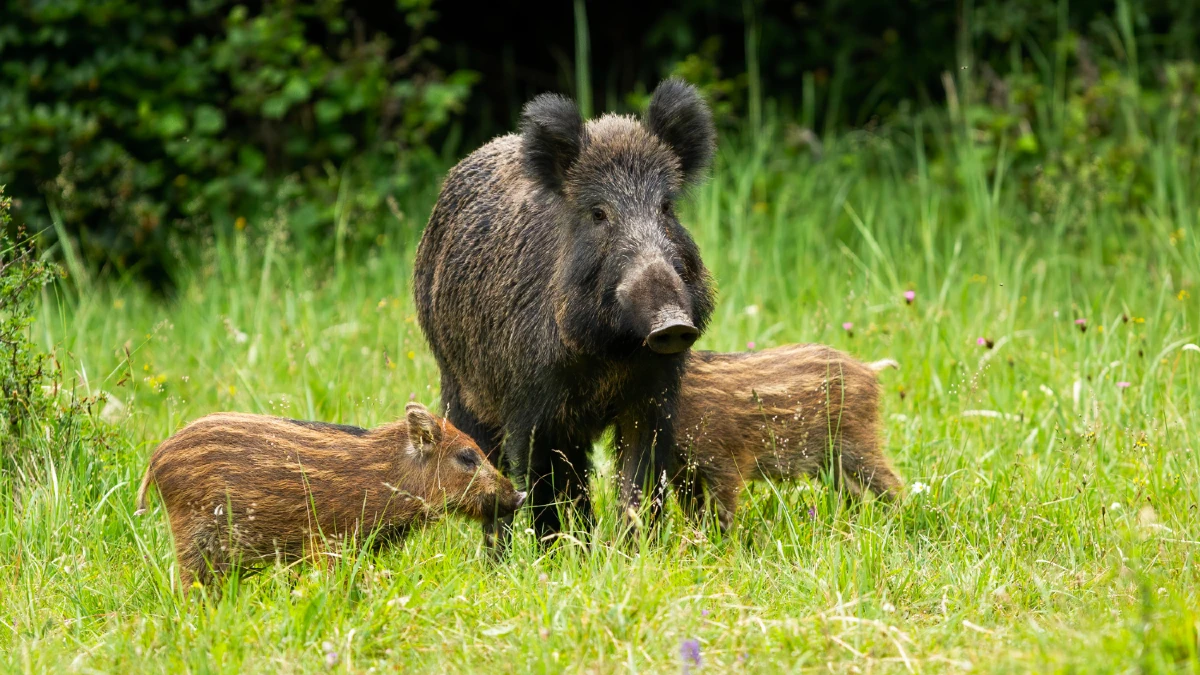
Faced with growing damage caused by wild boar across several parts of Portugal, the government is moving from promises to action. A new pilot scheme has been launched in 65 municipalities across mainland Portugal, offering an unusual incentive: financial rewards for additional wild boar culled in participating hunting areas.
The payments have been set at €50 for each male and €70 for each female. However, the scheme does not reward every animal killed. Payments will only apply to wild boar culled above the historical average recorded in each hunting area.
Running until 31 May 2027, the trial aims to establish whether targeted increases in culling can genuinely reduce damage to farmland, encounters near residential areas and collisions on the country’s roads.
More than 1,300 hunting areas included in the scheme
Led by Portugal’s Ministry of Agriculture and the Sea in partnership with the Institute for Nature Conservation and Forests (ICNF), the initiative covers more than 1,300 hunting areas across 65 municipalities and 15 districts. A total budget of €500,000 has been allocated.
Rather than paying hunters for animals that might have been culled anyway, the authorities will use each hunting area’s historical figures as a baseline. Only additional animals killed beyond that average will qualify for payment, with a maximum allowance of €2,000 per hunting area.
An extra €10 per animal will be available when the carcass is delivered to an approved game-processing facility. This measure also addresses a practical challenge: what happens to the meat if the number of animals culled increases significantly?
Pre-registration opened on 14 October. The participating municipalities were selected according to several criteria, including agricultural and forestry damage, road accidents, the geographical spread of wild boar and potential animal health risks.
The programme is intended not only to increase culling in affected areas but also to test whether such incentives can produce measurable improvements.
Farmers face mounting damage across rural Portugal
Behind the government’s decision lies an increasingly difficult reality for farmers and rural communities.
In São Pedro do Sul, in northern Portugal, the local authority has already allocated €13,000 to eleven hunting associations to strengthen wild boar control efforts.
Farmers describe animals capable of destroying cultivated fields in a matter of hours. For smaller agricultural businesses, repeated losses can become a serious financial burden, sometimes threatening the viability of particular crops.
Similar concerns have emerged in Médio Tejo, in central Portugal, where all eleven municipalities in the intermunicipal community expressed interest in taking part in the pilot scheme.
In Mação, wild boar have been reported on private properties and near residential neighbourhoods. In neighbouring Sardoal, the municipal authorities have chosen to fund organised hunts carried out by local hunting associations following reports of animals approaching villages and roads.
The problem is therefore no longer confined to damaged fields and lost harvests. The increasing presence of wild boar near homes and on roads has become a major argument behind calls for more active population management.
How many wild boar are there in Portugal?
One of the biggest challenges facing the authorities is a surprisingly basic question: nobody knows exactly how many wild boar live in Portugal.
Available estimates suggest a population of between 300,000 and 400,000 animals, with tens of thousands culled each year. However, these figures remain uncertain, partly because not every animal killed is necessarily recorded in official statistics.
The government is therefore seeking more than an immediate increase in culling. The pilot programme is also expected to generate data that can help assess the effectiveness of interventions in the areas experiencing the greatest problems.
That distinction matters. Killing more animals does not automatically mean that wild boar populations will decline sustainably, or that agricultural damage and road accidents will fall by the same proportion.
The results will need to be measured against what actually happens on the ground, rather than simply counting the number of animals removed.
Will culling alone be enough to control the population?
Portuguese environmental organisation Quercus has expressed reservations about the approach.
The association points out that an earlier wild boar management plan produced by the ICNF had already concluded that recreational hunting alone was insufficient to control the species’ expansion and its wider impacts.
Quercus argues for a broader strategy combining crop protection, habitat management, improved hunting practices and consideration of the role played by natural predators.
The organisation also wants wild boar population densities to be properly assessed both before and after the trial, allowing the authorities to determine whether the scheme has delivered meaningful results.
This highlights the central uncertainty surrounding the government’s experiment. Will financial incentives lead to a lasting reduction in damage, or merely increase the number of animals killed in the short term?
The answer may depend as much on where and how interventions take place as on the number of wild boar culled.
A nationwide challenge with results expected in 2027
The pilot scheme is scheduled to conclude on 31 May 2027, giving the Portuguese authorities several months to assess its effects across the participating municipalities.
By then, they should have a clearer picture of whether rewarding additional culling can help protect crops, improve road safety and reduce encounters between wild boar and residents.
For affected farmers and rural communities, the need for effective action is already pressing. But the wider debate raises questions about how Portugal manages wildlife populations, protects agricultural livelihoods and balances conservation with public safety.
Paying up to €70 per wild boar may provide part of the answer. Whether it offers a lasting solution remains to be seen.